


Get IAPP CIPT Dumps Questions [2026] To Gain Brilliant Result
CIPT dumps - VCEPrep - 100% Passing Guarantee
NEW QUESTION # 28
A privacy engineer reviews a newly developed on-line registration page on a company's website. The purpose of the page is to enable corporate customers to submit a returns / refund request for physical goods. The page displays the following data capture fields: company name, account reference, company address, contact name, email address, contact phone number, product name, quantity, issue description and company bank account details.
After her review, the privacy engineer recommends setting certain capture fields as "non-mandatory". Setting which of the following fields as "non-mandatory" would be the best example of the principle of data minimization?
- A. The contact phone number field.
- B. The contact name and email address.
- C. The company bank account detail field.
- D. The company address and name.
Answer: D
NEW QUESTION # 29
When releasing aggregates, what must be performed to magnitude data to ensure privacy?
- A. Value swapping.
- B. Basic rounding.
- C. Noise addition.
- D. Top coding.
Answer: C
NEW QUESTION # 30
A development team is asked to perform a Privacy Impact Assessment (PIA) for a new system that will collect personal information. The team considers the impact to Primary Users and Secondary Users in their PIA. What is a third type of user that they should consider as a part of the PIA?
- A. Standard Users.
- B. Development Users.
- C. Incidental Users.
- D. Administrative Users.
Answer: C
Explanation:
CIPT's treatment of Privacy Impact Assessments (PIAs) emphasizes evaluating privacy risks for all individuals whose data may be impacted, including those not directly or intentionally interacting with the system.
PIA user categories typically include:
* Primary Users # the main users the system is designed for
* Secondary Users # users who benefit indirectly or have supporting roles
* Incidental Users # individuals affected indirectly or unintentionally Incidental Users are:
* People whose data may be collected incidentally
* Bystanders captured via sensors, cameras, logs, or tracking
* Individuals affected by automated decisions though they are not direct system users
* A core focus of PIAs under CIPT because privacy risk often extends beyond intended data subjects CIPT frameworks highlight that privacy risks often affect people beyond direct users, so PIAs must capture all categories.
Why other options are incorrect:
* A - Administrative Users: These are part of internal access profiles, not a distinct "privacy impact" user category.
* B - Standard Users: Not a recognized PIA user classification; overlaps with primary users.
* D - Development Users: Developers are system builders, not data-subject categories considered in a PIA.
# Correct answer: C
NEW QUESTION # 31
SCENARIO
Please use the following to answer the next question:
Chuck, a compliance auditor for a consulting firm focusing on healthcare clients, was required to travel to the client's office to perform an onsite review of the client's operations. He rented a car from Finley Motors upon arrival at the airport as so he could commute to and from the client's office. The car rental agreement was electronically signed by Chuck and included his name, address, driver's license, make/model of the car, billing rate, and additional details describing the rental transaction. On the second night, Chuck was caught by a red light camera not stopping at an intersection on his way to dinner. Chuck returned the car back to the car rental agency at the end week without mentioning the infraction and Finley Motors emailed a copy of the final receipt to the address on file.
Local law enforcement later reviewed the red light camera footage. As Finley Motors is the registered owner of the car, a notice was sent to them indicating the infraction and fine incurred. This notice included the license plate number, occurrence date and time, a photograph of the driver, and a web portal link to a video clip of the violation for further review. Finley Motors, however, was not responsible for the violation as they were not driving the car at the time and transferred the incident to AMP Payment Resources for further review. AMP Payment Resources identified Chuck as the driver based on the rental agreement he signed when picking up the car and then contacted Chuck directly through a written letter regarding the infraction to collect the fine.
After reviewing the incident through the AMP Payment Resources' web portal, Chuck paid the fine using his personal credit card. Two weeks later, Finley Motors sent Chuck an email promotion offering 10% off a future rental.
How can Finley Motors reduce the risk associated with transferring Chuck's personal information to AMP Payment Resources?
- A. By requesting AMP Payment Resources delete unnecessary datasets and only utilize what is necessary to process the violation notice.
- B. By transferring all information to separate datafiles and requiring AMP Payment Resources to combine the datasets during processing of the violation notice.
- C. By providing only the minimum necessary data to process the violation notice and masking all other information prior to transfer.
- D. By obfuscating the minimum necessary data to process the violation notice and require AMP Payment Resources to secure store the personal information.
Answer: C
NEW QUESTION # 32
Granting data subjects the right to have data corrected, amended, or deleted describes?
- A. Accountability.
- B. A security safeguard
- C. Individual participation
- D. Use limitation.
Answer: C
NEW QUESTION # 33
SCENARIO
WebTracker Limited is a cloud-based online marketing service located in London. Last year, WebTracker migrated its IT infrastructure to the cloud provider AmaZure, which provides SQL Databases and Artificial Intelligence services to WebTracker. The roles and responsibilities between the two companies have been formalized in a standard contract, which includes allocating the role of data controller to WebTracker.
The CEO of WebTracker, Mr. Bond, would like to assess the effectiveness of AmaZure's privacy controls, and he recently decided to hire you as an independent auditor. The scope of the engagement is limited only to the marketing services provided by WebTracker, you will not be evaluating any internal data processing activity, such as HR or Payroll.
This ad-hoc audit was triggered due to a future partnership between WebTracker and SmartHome - a partnership that will not require any data sharing. SmartHome is based in the USA, and most recently has dedicated substantial resources to developing smart refrigerators that can suggest the recommended daily calorie intake based on DNA information. This and other personal data is collected by WebTracker.
To get an idea of the scope of work involved, you have decided to start reviewing the company's documentation and interviewing key staff to understand potential privacy risks.
The results of this initial work include the following notes:
* There are several typos in the current privacy notice of WebTracker, and you were not able to find the privacy notice for SmartHome.
* You were unable to identify all the sub-processors working for SmartHome. No subcontractor is indicated in the cloud agreement with AmaZure, which is responsible for the support and maintenance of the cloud infrastructure.
* There are data flows representing personal data being collected from the internal employees of WebTracker, including an interface from the HR system.
* Part of the DNA data collected by WebTracker was from employees, as this was a prototype approved by the CEO of WebTracker.
* All the WebTracker and SmartHome customers are based in USA and Canada.
Which of the following issues is most likely to require an investigation by the Chief Privacy Officer (CPO) of WebTracker?
- A. File Integrity Monitoring is being deployed in SQL servers, as indicated by the IT Architect Manager.
- B. Data flows use encryption for data at rest, as defined by the IT manager.
- C. Employees' personal data are being stored in a cloud HR system, as approved by the HR Manager.
- D. AmaZure sends newsletter to WebTracker customers, as approved by the Marketing Manager.
Answer: D
NEW QUESTION # 34
What is the best way to protect privacy on a geographic information system (GIS)?
- A. Using a firewall.
- B. Using a wireless encryption protocol.
- C. Limiting the data provided to the system.
- D. Scrambling location information.
Answer: C
Explanation:
The best way to protect privacy on a geographic information system (GIS) is by limiting the data provided to the system.
* Explanation:
* Data Minimization Principle: This principle states that only the minimum necessary data should be collected and processed for any given purpose. By limiting the data provided to the GIS, the risk of exposing sensitive or personal information is reduced.
* Privacy by Design: Implementing privacy by design involves integrating privacy considerations into the design and operation of technologies, such as GIS. This includes data minimization, ensuring data is relevant, adequate, and not excessive.
* Regulatory Compliance: Many privacy regulations, including GDPR, emphasize the importance of data minimization to protect personal information.
* GIS and Personal Data: Geographic data can often be highly sensitive, revealing patterns of movement, personal habits, and location-based data. Ensuring only necessary data is included in GIS datasets helps protect individual privacy.
References:
* IAPP Privacy Management, Information Privacy Technologist Certification Textbooks
* GDPR Article 5 (Principles relating to processing of personal data)
* NIST Special Publication 800-122: Guide to Protecting the Confidentiality of Personally Identifiable Information (PII)
NEW QUESTION # 35
Which of the following is an example of an appropriation harm?
- A. A hacker gains access to your email account and reads your messages.
- B. An unauthorized individual obtains access to your personal information and uses it for medical fraud.
- C. A govemment agency uses cameras to monitor your movements in a public area.
- D. A friend takes and uploads your pictures to a social media website.
Answer: B
Explanation:
Appropriation harms occur when someone's personal information is used without their consent, often for malicious purposes. An unauthorized individual obtaining access to personal information and using it for medical fraud is a clear example of appropriation harm because it involves the misuse of someone's personal data for fraudulent activities, potentially causing significant financial and personal damage to the victim. The IAPP emphasizes that appropriation harms are serious privacy violations that require stringent safeguards to protect individuals' personal data from unauthorized use.
NEW QUESTION # 36
SCENARIO
Please use the following to answer the next question:
Light Blue Health (LBH) is a healthcare technology company developing a new web and mobile application that collects personal health information from electronic patient health records. The application will use machine learning to recommend potential medical treatments and medications based on information collected from anonymized electronic health records. Patient users may also share health data collected from other mobile apps with the LBH app.
The application requires consent from the patient before importing electronic health records into the application and sharing it with their authorized physicians or healthcare provider. The patient can then review and share the recommended treatments with their physicians securely through the app. The patient user may also share location data and upload photos in the app. The patient user may also share location data and upload photos in the app for a healthcare provider to review along with the health record. The patient may also delegate access to the app.
LBH's privacy team meets with the Application development and Security teams, as well as key business stakeholders on a periodic basis. LBH also implements Privacy by Design (PbD) into the application development process.
The Privacy Team is conducting a Privacy Impact Assessment (PIA) to evaluate privacy risks during development of the application. The team must assess whether the application is collecting descriptive, demographic or any other user related data from the electronic health records that are not needed for the purposes of the application. The team is also reviewing whether the application may collect additional personal data for purposes for which the user did not provide consent.
Regarding the app, which action is an example of a decisional interference violation?
- A. The app has a pop-up ad requesting sign-up for a pharmaceutical company newsletter.
- B. The app sells aggregated data to an advertising company without prior consent.
- C. The app asks income level to determine the treatment of care.
- D. The app asks questions during account set-up to disclose family medical history that is not necessary for the treatment of the individual's symptoms.
Answer: C
NEW QUESTION # 37
SCENARIO
Please use the following to answer the next question:
Jordan just joined a fitness-tracker start-up based in California, USA, as its first Information Privacy and Security Officer. The company is quickly growing its business but does not sell any of the fitness trackers itself. Instead, it relies on a distribution network of third-party retailers in all major countries. Despite not having any stores, the company has a 78% market share in the EU. It has a website presenting the company and products, and a member section where customers can access their information. Only the email address and physical address need to be provided as part of the registration process in order to customize the site to the user's region and country. There is also a newsletter sent every month to all members featuring fitness tips, nutrition advice, product spotlights from partner companies based on user behavior and preferences.
Jordan says the General Data Protection Regulation (GDPR) does not apply to the company. He says the company is not established in the EU, nor does it have a processor in the region. Furthermore, it does not do any "offering goods or services" in the EU since it does not do any marketing there, nor sell to consumers directly. Jordan argues that it is the customers who chose to buy the products on their own initiative and there is no "offering" from the company.
The fitness trackers incorporate advanced features such as sleep tracking, GPS tracking, heart rate monitoring. wireless syncing, calorie-counting and step-tracking. The watch must be paired with either a smartphone or a computer in order to collect data on sleep levels, heart rates, etc. All information from the device must be sent to the company's servers in order to be processed, and then the results are sent to the smartphone or computer. Jordan argues that there is no personal information involved since the company does not collect banking or social security information.
Based on the current features of the fitness watch, what would you recommend be implemented into each device in order to most effectively ensure privacy?
- A. A2DP Bluetooth profile.
- B. Hashing.
- C. Randomized MAC address.
- D. Persistent unique identifier.
Answer: C
Explanation:
To most effectively ensure privacy in the fitness watch described in the scenario provided in the exhibit you shared, one feature that could be implemented into each device would be option D: Randomized MAC address.
NEW QUESTION # 38
Combining multiple pieces of information about an individual to produce a whole that is greater than the sum of its parts is called?
- A. Exclusion.
- B. Identification.
- C. Aggregation.
- D. Insecurity.
Answer: C
Explanation:
Aggregation involves the combination of various data points to create a more comprehensive profile or dataset that provides greater insight than the individual pieces alone. This technique can pose privacy risks because it may reveal patterns and personal information that were not apparent when the data points were viewed separately. This practice is often discussed in privacy and data protection contexts where it can lead to inadvertent breaches of privacy if not managed properly.
Reference:
NIST Special Publication 800-122, Guide to Protecting the Confidentiality of Personally Identifiable Information (PII).
NEW QUESTION # 39
A jurisdiction requiring an organization to place a link on the website that allows a consumer to opt-out of sharing is an example of what type of requirement?
- A. Technical
- B. Functional
- C. Operational
- D. Use case
Answer: C
Explanation:
a jurisdiction requiring an organization to place a link on their website that allows consumers to opt-out of sharing their personal data is an example of an operational requirement. Operational requirements involve implementing specific processes or procedures in order to comply with legal or regulatory obligations.
NEW QUESTION # 40
Which of the following would be the best method of ensuring that Information Technology projects follow Privacy by Design (PbD) principles?
- A. Develop training programs that aid the developers in understanding how to turn privacy requirements into actionable code and design level specifications.
- B. Utilize Privacy Enhancing Technologies (PETs) as a part of product risk assessment and management.
- C. Identify the privacy requirements as a part of the Privacy Impact Assessment (PIA) process during development and evaluation stages.
- D. Develop a technical privacy framework that integrates with the development lifecycle.
Answer: A
NEW QUESTION # 41
SCENARIO
Please use the following to answer the next question:
Light Blue Health (LBH) is a healthcare technology company developing a new web and mobile application that collects personal health information from electronic patient health records. The application will use machine learning to recommend potential medical treatments and medications based on information collected from anonymized electronic health records. Patient users may also share health data collected from other mobile apps with the LBH app.
The application requires consent from the patient before importing electronic health records into the application and sharing it with their authorized physicians or healthcare provider. The patient can then review and share the recommended treatments with their physicians securely through the app. The patient user may also share location data and upload photos in the app. The patient user may also share location data and upload photos in the app for a healthcare provider to review along with the health record. The patient may also delegate access to the app.
LBH's privacy team meets with the Application development and Security teams, as well as key business stakeholders on a periodic basis. LBH also implements Privacy by Design (PbD) into the application development process.
The Privacy Team is conducting a Privacy Impact Assessment (PIA) to evaluate privacy risks during development of the application. The team must assess whether the application is collecting descriptive, demographic or any other user related data from the electronic health records that are not needed for the purposes of the application. The team is also reviewing whether the application may collect additional personal data for purposes for which the user did not provide consent.
What is the best way to ensure that the application only collects personal data that is needed to fulfill its primary purpose of providing potential medical and healthcare recommendations?
- A. Obtain consent before using personal health information for data analytics purposes.
- B. Provide the user with an option to select which personal data the application may collect.
- C. Document each personal category collected by the app and ensure it maps to an app function or feature.
- D. Disclose what personal data the application the collecting in the company Privacy Policy posted online.
Answer: C
Explanation:
Primary Purpose Principle: Ensuring that data collection is strictly for fulfilling the primary purpose helps in maintaining data minimization and relevance.
Mapping Data to Functionality: Documenting each personal data category and mapping it to specific app functions or features ensures that only the necessary data is collected and used. This approach adheres to the principle of data minimization, a core aspect of Privacy by Design.
Data Inventory and Mapping: Creating a comprehensive data inventory that links each piece of personal data to its specific use case in the application helps in justifying the necessity of data collection and provides transparency.
Reference: The IAPP guidelines on conducting Privacy Impact Assessments (PIAs) highlight the importance of data mapping in identifying and documenting the personal data collected and ensuring it aligns with the application's functionalities and purposes.
NEW QUESTION # 42
SCENARIO
Please use the following to answer the next question:
Light Blue Health (LBH) is a healthcare technology company developing a new web and mobile application that collects personal health information from electronic patient health records. The application will use machine learning to recommend potential medical treatments and medications based on information collected from anonymized electronic health records. Patient users may also share health data collected from other mobile apps with the LBH app.
The application requires consent from the patient before importing electronic health records into the application and sharing it with their authorized physicians or healthcare provider. The patient can then review and share the recommended treatments with their physicians securely through the app. The patient user may also share location data and upload photos in the app. The patient user may also share location data and upload photos in the app for a healthcare provider to review along with the health record. The patient may also delegate access to the app.
LBH's privacy team meets with the Application development and Security teams, as well as key business stakeholders on a periodic basis. LBH also implements Privacy by Design (PbD) into the application development process.
The Privacy Team is conducting a Privacy Impact Assessment (PIA) to evaluate privacy risks during development of the application. The team must assess whether the application is collecting descriptive, demographic or any other user related data from the electronic health records that are not needed for the purposes of the application. The team is also reviewing whether the application may collect additional personal data for purposes for which the user did not provide consent.
The Privacy Team is conducting a Privacy Impact Assessment (PIA) for the new Light Blue Health application currently in development. Which of the following best describes a risk that is likely to result in a privacy breach?
- A. Limiting access to the app to authorized personnel.
- B. Not encrypting the health record when it is transferred to the Light Blue Health servers.
- C. Including non-transparent policies, terms and conditions in the app.
- D. Insufficiently deleting personal data after an account reaches its retention period.
Answer: A
NEW QUESTION # 43
An organization uses artificially created data from a raw data set that has the same statistical characteristics to enable researchers to use relevant data points without exposing personal data. This is an example of what?
- A. Privacy Enhancing Technologies (PET).
- B. Machine Learning (ML).
- C. Artificial Intelligence (AI).
- D. Privacy by Design (PbD).
Answer: A
Explanation:
The scenario describes the use of synthetic data - artificially generated data created to maintain statistical similarity to real data without exposing actual personal information. Synthetic data is explicitly categorized under Privacy Enhancing Technologies (PETs) in CIPT materials.
PETs are technologies designed to:
* Reduce or eliminate the handling of identifiable personal data
* Protect individuals during processing
* Support analytics, testing, and research while preserving privacy
Synthetic data is highlighted as a PET because it:
* Allows safe data use for research/testing
* Minimizes privacy risk
* Avoids exposure of real personal data
* Supports data minimization and privacy-by-design principles
Why the other options are incorrect:
* A (ML) # ML may use synthetic data but synthetic data itself is not ML.
* B (PbD) # PETs support PbD, but the technology itself is specifically a PET.
* C (AI) # AI is a broad concept; synthetic data generation does not equal AI.
# Correct: D
NEW QUESTION # 44
SCENARIO - Please use the following to answer the next question:
Kyle is a new security compliance manager who will be responsible for coordinating and executing controls to ensure compliance with the company s information security policy and industry standards. Kyle is also-new to the company, where collaboration is a core value. On his first day of new-hire orientation, Kyle s schedule included participating in meetings and observing work in the IT and compliance departments.
Kyle spent the morning in the IT department, where the CIO welcomed him and explained that her department was responsible for IT governance. The CIO and Kyle engaged in a conversation about the importance of identifying meaningful IT governance metrics. Following their conversation, the CIO introduced Kyle to Ted and Barney. Ted is implementing a plan to encrypt data at the transportation level of the organization s wireless network. Kyle would need to get up to speed on the project and suggest ways to monitor effectiveness once the implementation was complete. Barney explained that his short-term goals are to establish rules governing where data can be placed and to minimize the use of offline data storage.
Kyle spent the afternoon with Jill, a compliance specialist, and learned that she was exploring an initiative for a compliance program to follow self-regulatory privacy principles. Thanks to a recent internship, Kyle had some experience in this area and knew where Jill could find some support. Jill also shared results of the company s privacy risk assessment, noting that the secondary use of personal information was considered a high risk.
By the end of the day, Kyle was very excited about his new job and his new company. In fact, he learned about an open position for someone with strong qualifications and experience with access privileges, project standards board approval processes, and application-level obligations, and couldn't wait to recommend his friend Ben who would be perfect for the job.
Which of the following should Kyle recommend to Jill as the best source of support for her initiative?
- A. Regulators.
- B. Corporate researchers.
- C. Investors.
- D. Industry groups.
Answer: A
NEW QUESTION # 45
Which technique is most likely to facilitate the deletion of every instance of data associated with a deleted user account from every data store held by an organization?
- A. Training engineering teams on the importance of deleting user accounts their associated data from all data stores when requested.
- B. Monitoring each data store for presence of data associated with the deleted user account.
- C. Auditing the code which deletes user accounts.
- D. Building a standardized and documented retention program for user data deletion.
Answer: D
Explanation:
To effectively facilitate the deletion of every instance of data associated with a deleted user account from all data stores, the most reliable approach is to build a standardized and documented retention program for user data deletion. This program ensures a systematic process for identifying and removing user data across all data stores in the organization, ensuring compliance with data protection principles. By having a documented policy, the organization can maintain consistency and accountability in data deletion processes. This method is recommended by data privacy standards and is elaborated in IAPP's Information Privacy Technologist resources.
NEW QUESTION # 46
SCENARIO
Clean-Q is a company that offers house-hold and office cleaning services. The company receives requests from consumers via their website and telephone, to book cleaning services. Based on the type and size of service, Clean-Q then contracts individuals that are registered on its resource database - currently managed in-house by Clean-Q IT Support. Because of Clean-Q's business model, resources are contracted as needed instead of permanently employed.
The table below indicates some of the personal information Clean-Q requires as part of its business operations: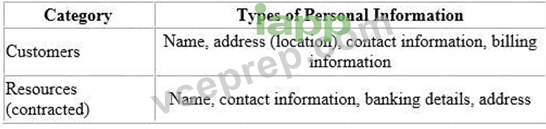
Clean-Q has an internal employee base of about 30 people. A recent privacy compliance exercise has been conducted to align employee data management and human resource functions with applicable data protection regulation. Therefore, the Clean-Q permanent employee base is not included as part of this scenario.
With an increase in construction work and housing developments, Clean-Q has had an influx of requests for cleaning services. The demand has overwhelmed Clean-Q's traditional supply and demand system that has caused some overlapping bookings.
Ina business strategy session held by senior management recently, Clear-Q invited vendors to present potential solutions to their current operational issues. These vendors included Application developers and Cloud-Q's solution providers, presenting their proposed solutions and platforms.
The Managing Director opted to initiate the process to integrate Clean-Q's operations with a cloud solution (LeadOps) that will provide the following solution one single online platform: A web interface that Clean-Q accesses for the purposes of resource and customer management. This would entail uploading resource and customer information.
* A customer facing web interface that enables customers to register, manage and submit cleaning service requests online.
* A resource facing web interface that enables resources to apply and manage their assigned jobs.
* An online payment facility for customers to pay for services.
Considering that LeadOps will host/process personal information on behalf of Clean-Q remotely, what is an appropriate next step for Clean-Q senior management to assess LeadOps' appropriateness?
- A. Nothing at this stage as the Managing Director has made a decision.
- B. Obtain a legal opinion from an external law firm on contracts management.
- C. Determine if any Clean-Q competitors currently use LeadOps as a solution.
- D. Involve the Information Security team to understand in more detail the types of services and solutions LeadOps is proposing.
Answer: D
NEW QUESTION # 47
Which activity would best support the principle of data quality?
- A. Ensuring that information remains accurate.
- B. Providing notice to the data subject regarding any change in the purpose for collecting such data.
- C. Delivering information in a format that the data subject understands.
- D. Ensuring that the number of teams processing personal information is limited.
Answer: A
Explanation:
Ensuring that information remains accurate is the activity that best supports the principle of data quality. Data quality principles emphasize the importance of keeping personal information correct, complete, and up-to-date to prevent harm and ensure reliability. Maintaining accuracy involves regular updates, validation, and correction processes to avoid using outdated or incorrect data (IAPP, Certified Information Privacy Technologist (CIPT) materials).
NEW QUESTION # 48
SCENARIO
Clean-Q is a company that offers house-hold and office cleaning services. The company receives requests from consumers via their website and telephone, to book cleaning services. Based on the type and size of service, Clean-Q then contracts individuals that are registered on its resource database - currently managed in- house by Clean-Q IT Support. Because of Clean-Q's business model, resources are contracted as needed instead of permanently employed.
The table below indicates some of the personal information Clean-Q requires as part of its business operations:
Clean-Q has an internal employee base of about 30 people. A recent privacy compliance exercise has been conducted to align employee data management and human resource functions with applicable data protection regulation. Therefore, the Clean-Q permanent employee base is not included as part of this scenario.
With an increase in construction work and housing developments, Clean-Q has had an influx of requests for cleaning services. The demand has overwhelmed Clean-Q's traditional supply and demand system that has caused some overlapping bookings.
Ina business strategy session held by senior management recently, Clear-Q invited vendors to present potential solutions to their current operational issues. These vendors included Application developers and Cloud-Q's solution providers, presenting their proposed solutions and platforms.
The Managing Director opted to initiate the process to integrate Clean-Q's operations with a cloud solution (LeadOps) that will provide the following solution one single online platform: A web interface that Clean-Q accesses for the purposes of resource and customer management. This would entail uploading resource and customer information.
* A customer facing web interface that enables customers to register, manage and submit cleaning service requests online.
* A resource facing web interface that enables resources to apply and manage their assigned jobs.
* An online payment facility for customers to pay for services.
Considering that LeadOps will host/process personal information on behalf of Clean-Q remotely, what is an appropriate next step for Clean-Q senior management to assess LeadOps' appropriateness?
- A. Nothing at this stage as the Managing Director has made a decision.
- B. Obtain a legal opinion from an external law firm on contracts management.
- C. Determine if any Clean-Q competitors currently use LeadOps as a solution.
- D. Involve the Information Security team to understand in more detail the types of services and solutions LeadOps is proposing.
Answer: D
Explanation:
Given that LeadOps will host/process personal information on behalf of Clean-Q remotely, it is crucial to involve the Information Security team to understand in more detail the types of services and solutions LeadOps is proposing.
* Explanation:
* Security Assessment: The Information Security team should evaluate LeadOps' security measures, data protection practices, and compliance with relevant regulations. This assessment ensures that the service provider has adequate safeguards to protect personal information.
* Risk Management: Understanding the security environment helps identify potential risks associated with outsourcing data processing. This includes assessing encryption practices, data storage policies, and incident response plans.
* Vendor Due Diligence: Conducting thorough due diligence on LeadOps helps determine their capability to handle sensitive data securely. This can involve reviewing their security certifications, audits, and compliance with industry standards like ISO 27001.
* Legal and Compliance Considerations: Involving the Information Security team ensures that Clean-Q adheres to data protection regulations such as GDPR or CCPA, which require businesses to ensure their processors provide adequate data protection.
References:
IAPP Privacy Management, Information Privacy Technologist Certification Textbooks ISO/IEC 27001 - Information Security Management Systems GDPR Articles 28 and 32
NEW QUESTION # 49
SCENARIO
Please use the following to answer the next questions:
Your company is launching a new track and trace health app during the outbreak of a virus pandemic in the US. The developers claim the app is based on privacy by design because personal data collected was considered to ensure only necessary data is captured, users are presented with a privacy notice, and they are asked to give consent before data is shared. Users can update their consent after logging into an account, through a dedicated privacy and consent hub. This is accessible through the 'Settings' icon from any app page, then clicking 'My Preferences', and selecting 'Information Sharing and Consent' where the following choices are displayed:
* "I consent to receive notifications and infection alerts";
* "I consent to receive information on additional features or services, and new products";
* "I consent to sharing only my risk result and location information, for exposure and contact tracing purposes";
* "I consent to share my data for medical research purposes"; and
* "I consent to share my data with healthcare providers affiliated to the company".
For each choice, an ON* or OFF tab is available The default setting is ON for all Users purchase a virus screening service for USS29 99 for themselves or others using the app The virus screening service works as follows:
* Step 1 A photo of the user's face is taken.
* Step 2 The user measures their temperature and adds the reading in the app
* Step 3 The user is asked to read sentences so that a voice analysis can detect symptoms
* Step 4 The user is asked to answer questions on known symptoms
* Step 5 The user can input information on family members (name date of birth, citizenship, home address, phone number, email and relationship).) The results are displayed as one of the following risk status "Low. "Medium" or "High" if the user is deemed at "Medium " or "High" risk an alert may be sent to other users and the user is Invited to seek a medical consultation and diagnostic from a healthcare provider.
A user's risk status also feeds a world map for contact tracing purposes, where users are able to check if they have been or are in dose proximity of an infected person If a user has come in contact with another individual classified as "medium' or 'high' risk an instant notification also alerts the user of this. The app collects location trails of every user to monitor locations visited by an infected individual Location is collected using the phone's GPS functionary, whether the app is in use or not however, the exact location of the user is
"blurred' for privacy reasons Users can only see on the map circles
Which technology is best suited for the contact tracing feature of the app1?
- A. Deep learning
- B. Radio-Frequency Identification (RFID)
- C. Near Field Communication (NFC)
- D. Bluetooth
Answer: D
Explanation:
Bluetooth technology is best suited for the contact tracing feature of the app. Bluetooth allows for proximity detection, which is essential for determining if a user has been in close contact with an infected person. It can operate effectively within the range needed for contact tracing without the significant battery drain associated with GPS. This method aligns with privacy principles by providing proximity data without constantly tracking the exact location of users. References to this can be found in the IAPP's CIPT materials discussing privacy- preserving technologies and their applications in contact tracing.
NEW QUESTION # 50
SCENARIO
Clean-Q is a company that offers house-hold and office cleaning services. The company receives requests from consumers via their website and telephone, to book cleaning services. Based on the type and size of service, Clean-Q then contracts individuals that are registered on its resource database - currently managed in- house by Clean-Q IT Support. Because of Clean-Q's business model, resources are contracted as needed instead of permanently employed.
The table below indicates some of the personal information Clean-Q requires as part of its business operations:
Clean-Q has an internal employee base of about 30 people. A recent privacy compliance exercise has been conducted to align employee data management and human resource functions with applicable data protection regulation. Therefore, the Clean-Q permanent employee base is not included as part of this scenario.
With an increase in construction work and housing developments, Clean-Q has had an influx of requests for cleaning services. The demand has overwhelmed Clean-Q's traditional supply and demand system that has caused some overlapping bookings.
Ina business strategy session held by senior management recently, Clear-Q invited vendors to present potential solutions to their current operational issues. These vendors included Application developers and Cloud-Q's solution providers, presenting their proposed solutions and platforms.
The Managing Director opted to initiate the process to integrate Clean-Q's operations with a cloud solution (LeadOps) that will provide the following solution one single online platform: A web interface that Clean-Q accesses for the purposes of resource and customer management. This would entail uploading resource and customer information.
* A customer facing web interface that enables customers to register, manage and submit cleaning service requests online.
* A resource facing web interface that enables resources to apply and manage their assigned jobs.
* An online payment facility for customers to pay for services.
Which question would you most likely ask to gain more insight about LeadOps and provide practical privacy recommendations?
- A. What is LeadOps' annual turnover?
- B. Does LeadOps practice agile development and maintenance of their system?
- C. How big is LeadOps' employee base?
- D. Where are LeadOps' operations and hosting services located?
Answer: D
Explanation:
To gain more insight about LeadOps and provide practical privacy recommendations, asking where LeadOps' operations and hosting services are located is essential.
* Explanation:
* Data Residency and Sovereignty: The physical location of data processing and storage facilities impacts compliance with data protection laws. Different countries have different regulations concerning data privacy and security.
* Jurisdictional Issues: Knowing the location helps assess the legal jurisdiction governing the data. This includes understanding any potential requirements for data transfer, local laws, and the legal obligations LeadOps must comply with.
* Cross-Border Data Transfers: If data is hosted in a different country, Clean-Q must ensure that adequate safeguards are in place for cross-border data transfers. This is particularly relevant under GDPR, which requires appropriate data transfer mechanisms like Standard Contractual Clauses (SCCs) or Binding Corporate Rules (BCRs).
* Risk Assessment: The geopolitical stability and data protection framework of the hosting location can influence the security and privacy risks associated with using LeadOps.
References:
IAPP Privacy Management, Information Privacy Technologist Certification Textbooks GDPR Chapter V - Transfers of Personal Data to Third Countries or International Organizations NIST SP 800-37: Guide for Applying the Risk Management Framework to Federal Information Systems
NEW QUESTION # 51
......
Get 100% Passing Success With True CIPT Exam: https://www.vceprep.com/CIPT-latest-vce-prep.html
Premium Quality IAPP CIPT Online dumps: https://drive.google.com/open?id=161fbtDZwgMs8WrD3ixAM79yzt_ovCFoO