


2024 Easy Success HP HPE3-U01 Exam in First Try
Best HPE3-U01 Exam Dumps for the Preparation of Latest Exam Questions
HP HPE3-U01 certification exam is a great way to demonstrate your knowledge and expertise in Aruba networking solutions, and can help you advance your career in the IT industry. Achieving this certification can also provide you with a competitive advantage in the job market, as it validates your skills and knowledge in a highly sought-after area of expertise. Additionally, the certification can help you gain recognition within your organization and increase your credibility as a networking professional.
To prepare for the HPE3-U01 exam, candidates can take advantage of various resources offered by Aruba. Aruba provides an official study guide, online training courses, and hands-on experience through their Aruba Partner Ready for Networking program. Candidates can also find study materials and practice exams from third-party providers.
NEW QUESTION # 12
Whichcondition allows 5Ghz channels to avoid Adjacent Channel Interference?
- A. transmit at 40 MHz bandwidth
- B. transmit at low power levels
- C. transmit at high power levels
- D. transmit at 20 MHz bandwidth
Answer: A
NEW QUESTION # 13
To which wireless device category do a hardwire desktop PC belongs?
- A. intermittent mobile devices
- B. highly mobile devices
- C. somewhat mobile devices
- D. stationary devices
Answer: B
NEW QUESTION # 14
How many addresses does the 255.255.252.0 provide?
- A. 0
- B. 1
- C. 2
- D. 3
Answer: B
NEW QUESTION # 15
Refer to Exhibit.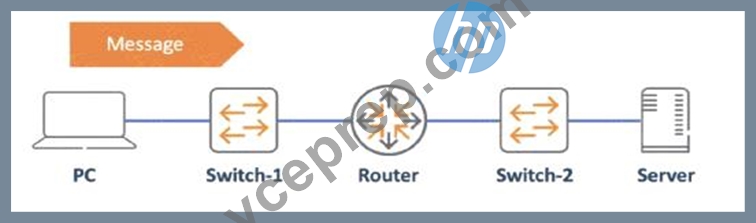
The PC is sending a message to the server. Which devices have performed Layer 2 encapsulation by the time the message arrives at the server? (Select two.)
- A. switch-2
- B. Router
- C. PC
- D. Switch-1
- E. Server
Answer: A,D
Explanation:
Explanation
Layer 2 encapsulation is the process of adding a header and a trailer to the data coming from the upper layer (Layer 3) before sending it over the physical medium. The header and the trailer contain information such as source and destination MAC addresses, error detection, and protocol type. The devices that perform Layer 2 encapsulation are usually switches, bridges, or network interface cards (NICs). In the given network diagram, the PC is sending a message to the server. The PC first adds a Layer 2 header and trailer to the data and sends it to Switch-1. Switch-1 performs Layer 2 encapsulation again before forwarding it to the router. The router operates at Layer 3 and does not perform Layer 2 encapsulation. It only removes the Layer 2 header and trailer, checks the destination IP address, and forwards the packet to the next hop. The packet then reaches Switch-2, where Layer 2 encapsulation occurs again before it is sent to the server. The server also performs Layer 2 de-encapsulation by removing the header and trailer and passing the data to the upper layer. Therefore, the devices that have performed Layer 2 encapsulation by the time the message arrives at the server are Switch-1 and Switch-2. References: Understanding Data Link Layer Encapsulation, How Data Encapsulation
& De-encapsulation Works?, HDLC Protocol and Encapsulation method Explained
NEW QUESTION # 16
Which protocol provides logical addressing used for routing messages across the network towards their destination?
- A. Transmission Control Protocol
- B. Internet Protocol
- C. Wired Ethernet
- D. Link Layer Discovery Protocol
Answer: B
Explanation:
Explanation
The protocol that provides logical addressing used for routing messages across the network towards their destination is the Internet Protocol (IP). IP is a network layer protocol that assigns a unique numerical identifier to each device on a network, called an IP address. IP addresses are used to identify the source and destination of data packets, and to determine the best path to deliver them. IP is a connectionless and best-effort protocol, meaning that it does not guarantee the delivery, order, or integrity of the packets. IP relies on other protocols, such as TCP, to provide reliable and orderly data transfer.
The other options are incorrect because:
B: Transmission Control Protocol (TCP) is a transport layer protocol that provides reliable and orderly data delivery by establishing a connection between devices and providing error-checking and retransmission mechanisms. TCP does not provide logical addressing or routing functions, but it uses IP addresses to identify the endpoints of a connection.
C: Wired Ethernet is a data link layer protocol that defines the physical and logical characteristics of a wired network, such as cable types, frame formats, and MAC addresses. MAC addresses are used to identify the physical devices on a network segment, but they are not used for routing messages across the network.
Ethernet does not provide logical addressing or routing functions, but it relies on IP to do so.
D: Link Layer Discovery Protocol (LLDP) is a data link layer protocol that allows devices to discover and advertise information about themselves and their neighbors on a network, such as device type, capabilities, port configuration, and VLAN membership. LLDP does not provide logical addressing or routing functions, but it can help network administrators to troubleshoot and optimize the network topology. References:
* Aruba Certified Network Technician (ACNT) | HPE Aruba Networking
* Network Layer Protocols - GeeksforGeeks
* Network protocols and layers A Level Resources - Teach Computer Science
NEW QUESTION # 17
Refer to Exhibit.
To which protocol does the header belong?
- A. Transmission Control Protocol
- B. User Datagram Protocol
- C. 802.11 Wi-Fi
- D. Internet Protocol
- E. Ethernet Protocol
Answer: D
NEW QUESTION # 18
What are the key differences between L2 switches and routers? (Select two.)
- A. Switches build a MAC table while routers build a routing table.
- B. Routers offer a considerably higher port density than switches.
- C. Switches are considered L2 devices, while routers are L4.
- D. Switches build an ARP table, while routers build a port table.
- E. Switches offer a considerably higher port density than routers.
Answer: A,E
NEW QUESTION # 19
What is the binary equivalent of the decimal number of 233?
- A. 0
- B. 1
- C. 2
- D. 3
Answer: C
Explanation:
Explanation
The binary equivalent of the decimal number of 233 is 11101001. To find this, we can use the following method:
* Divide 233 by 2 and write down the remainder. The remainder is either 0 or 1.
* Divide the quotient by 2 and write down the new remainder.
* Repeat this process until the quotient is 0.
* Write the remainders from the bottom to the top. This is the binary equivalent.
For example:
Table
Quotient
Remainder
233 / 2
1
116 / 2
0
58 / 2
0
29 / 2
1
14 / 2
0
7 / 2
1
3 / 2
1
1 / 2
1
0 / 2
0
The remainders from the bottom to the top are 11101001, which is the binary equivalent of 233.
References:
1: Decimal to Binary Converter - RapidTables 2: How to Convert Decimal to Binary - wikiHow 3: Decimal to Binary Conversion Methods - GeeksforGeeks
NEW QUESTION # 20
What is part of the 5 GHz band?
- A. Channels 149 to 161
- B. U-NII 5
- C. Channel 14
- D. Channel 12 and 13
Answer: A
Explanation:
Explanation
The 5 GHz band is a radio frequency band used for Wi-Fi communications. It has a higherdata bandwidth than the 2.4 GHz band, but a shorter range and less penetration through walls. The 5 GHz band is divided into several sub-bands, each with a different set of channels. One of these sub-bands is the U-NII-3 band, which covers the frequency range from 5725 MHz to 5850 MHz. This sub-band contains 24 non-overlapping channels, numbered from 149 to 172. Channels 149 to 161 are part of the 5 GHz band and can be used for Wi-Fi communications. Channels 165 and 169 are restricted to indoor use only, and channel 173 is not allowed in some regions. Channels 12, 13, and 14 are not part of the 5 GHz band, but belong to the 2.4 GHz band, which has a different set of channels and regulations. U-NII-5 is not a valid sub-band name, but a proposed extension of the 5 GHz band to include the frequency range from 5925 MHz to 7125 MHz. This extension is not yet approved or implemented, and therefore not part of the 5 GHz band. References: List of WLAN channels, What's the Difference Between 2.4 and 5 GHz Wi-Fi (and Which Should I Use)?, What is the difference between 2.4 GHz, 5 GHz, and 6 GHz wireless frequencies?
NEW QUESTION # 21
Which accurately describes the 051 Model?
- A. It is a reference model that describes how data communications occur on a network.
- B. It is a reference model that explains how data is created by the application layer.
- C. It is a reference model that describes data flow over the network using four layers.
- D. It is a reference model that is used to convert binary bits into analog signals.
Answer: A
NEW QUESTION # 22
Which accurately describes the TCP/IP Model? (Select two.)
- A. It specifies how to compress, fragment, encrypt, and analyze data.
- B. It is a set of communication protocols used on Ethernet-based networks only.
- C. It specifies how to assemble, address, transmit, route, and disassemble a data packet.
- D. It is a set of communication protocols used on IP-based networks only.
- E. It is a set of communication protocols used on TCP-based networks only.
Answer: C,D
Explanation:
Explanation
The TCP/IP model is a hierarchical protocol for network communication. It consists of four layers: the application layer, the transport layer, the internet layer, and the network interface layer. Each layer has specific functions and protocols that enable data transmission over the internet123 The TCP/IP model does not specify how to compress, fragment, encrypt, or analyze data. These are functions that may be performed by some protocols at different layers, but they are not part of the TCP/IP model itself.
Therefore, option B is incorrect.
The TCP/IP model does not depend on the underlying physical network or data link technology. It can work on any network that supports IP addressing and routing, such as Ethernet, Wi-Fi, ATM, etc. Therefore, options A and E are incorrect.
The TCP/IP model specifies how to assemble, address, transmit, route, and disassemble a data packet. This is the core function of the internet layer, which uses the Internet Protocol (IP) to perform these tasks. IP is responsible for delivering packets from the source to the destination, based on the IP addresses of the hosts.
Therefore, option C is correct.
The TCP/IP model is a set of communication protocols used on IP-based networks only. This means that any network that supports the internet layer of the TCP/IP model can use the TCP/IP protocols. IP-based networks are the most common and widely used networks in the world, as they enable the interconnection of different networks and devices across the internet. Therefore, option D is correct. References: https://www.guru99.com/tcp-ip-model.html
https://www.javatpoint.com/computer-network-tcp-ip-model
NEW QUESTION # 23
Which statement accurately describes an omnidirectional antenna?
- A. Radiates almost equal power in all directions in the Horizontal Plane.
- B. Radiates almost equal power in all directions in the Vertical Plane.
- C. Radiates more power in a specific angle and less power in others.
- D. Radiates equal power in all directions in the Elevation Plane.
Answer: D
NEW QUESTION # 24
Which accurately describes the TCP/IP Model? (Select two.)
- A. It specifies how to compress, fragment, encrypt, and analyze data.
- B. It is a set of communication protocols used on Ethernet-based networks only.
- C. It specifies how to assemble, address, transmit, route, and disassemble a data packet.
- D. It is a set of communication protocols used on IP-based networks only.
- E. It is a set of communication protocols used on TCP-based networks only.
Answer: C,D
NEW QUESTION # 25
What are characteristics of Aruba Central? (Select two.)
- A. It manages networking equipment using SNMP.
- B. It is considered cloud-based network management.
- C. It must be deployed as an on-premises server.
- D. It manages networking equipment using HTTPs.
- E. It can manage third-party networking equipment.
Answer: B,D
NEW QUESTION # 26
Before routers forward unicast packets, what information is compared with the unicast routing table entries?
- A. The inbound port the packet is received in.
- B. The destination address of the IP header.
- C. The destination address of the Ethernet header.
- D. The source address of the IP header.
- E. The source address of the Ethernet header.
Answer: B
Explanation:
Explanation
Before routers forward unicast packets, they compare the destination address of the IP header with the unicast routing table entries. This is because routers use the destination IP address to determine the next hop or outgoing interface for the packet. Routers do not care about the source address of the IP header or the Ethernet header, as they are not relevant for forwarding decisions. The inbound port the packet is received in is also not important, as routers use the routing table to make forwarding decisions, not the interface information.
Therefore, the correct answer is
C: Referenceshttps://networklessons.com/cisco/ccie-routing-switching/unicast-reverse-path-forwarding-urpf
https://www.killtest.com/news_Aruba_Certified_Network_Technician_Exam_ACNT_HPE3-U01_Exam_Questi
NEW QUESTION # 27
What is the binary equivalent of the decimal number of 233?
- A. 0
- B. 1
- C. 2
- D. 3
Answer: C
NEW QUESTION # 28
What do the digits in the ArubaOS-CX switch interface numbering represent?
- A. Stack/Member/Port
- B. Module/Slot/Port
- C. Slot/Member/Port
- D. Member/Slot/Port
Answer: D
Explanation:
Explanation
The digits in the ArubaOS-CX switch interface numbering represent the member, slot, and port numbers of the physical ports and their corresponding logical software interfaces. The format is member / slot / port, where:
* Member: Member number of the switch in a Virtual Switching Framework (VSF) stack. Range: 1 to 8.
The primary switch is always member 1. VSF is a technology that allows multiple switches to operate as a single logical device, providing high availability, scalability, and simplified management.
* Slot: Slot number of the module on the switch chassis. Range: 1 to 6. The 6400 Switch Series has six slots for line cards, while the 8320, 8325, and 8400 Switch Series have four slots for line cards and two slots for management modules.
* Port: Port number of the interface on the module. Range: 1 to 48 for 1G/10G ports, 1 to 32 for 25G ports, and 1 to 8 for 40G/100G ports.
For example, interface 1/1/1 refers to the first port on the first module of the first switch in a VSF stack.
References:
* Identifying switch ports and interfaces
* ArubaOS-CX 10.05 Command-Line Interface Guide 6200 Switch Series
* ArubaOS-CX 10.04 Virtual Switching Extension (VSX) Guide
NEW QUESTION # 29
You are managing an ArubaOS-CX switch using the CLl. The current prompt reads "Switch(config-if>#".
Which single CLI command should you issue to move back to the Manager context?
- A. quit
- B. end
- C. disable
- D. exit
Answer: B
Explanation:
Explanation
The end command is used to exit from any configuration context and return to the manager context. The manager context is indicated by the # symbol at the end of the prompt. The manager context allows you to execute commands that do not require saving changes to the configuration, such as show or clear commands.
The disable command is used to exit from the manager context and return to the operator context, which is indicated by the > symbol. The quit and exit commands are used to exit from the current context and return to the parent context, such as from config-if to config. However, these commands do not move you directly to the manager context from any configuration context. Therefore, the correct answer is A.
end. References: Navigating to the manager context (#) - Aruba, Manager context (#) - Aruba
NEW QUESTION # 30
Refer to Exhibit.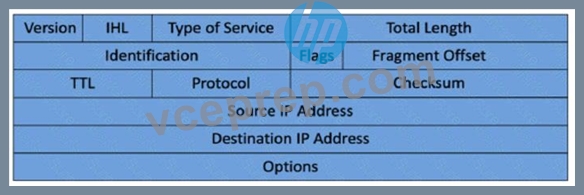
To which protocol does the header belong?
- A. Transmission Control Protocol
- B. User Datagram Protocol
- C. Internet Protocol
- D. Ethernet Protocol
- E. Internet Protocol version 6
Answer: C
Explanation:
Explanation
The header in the exhibit belongs to the Internet Protocol version 4 (IPv4), which is the most widely used protocol for routing and delivering packets across networks. IPv4 is a connectionless and unreliable protocol that operates at the network layer of the OSI model. The IPv4 header consists of 20 bytes (160 bits) of fixed fields and up to 40 bytes (320 bits) of optional fields. The fixed fields include:
* Version: 4 bits that indicate the version of the IP protocol, which is 4 for IPv4.
* IHL (Internet Header Length): 4 bits that indicate the length of the IP header in 32-bit words, which is 5 for the minimum header size of 20 bytes.
* Type of Service: 8 bits that indicate the quality of service (QoS) parameters for the packet, such as precedence, delay, throughput, and reliability.
* Total Length: 16 bits that indicate the total length of the IP packet in bytes, including the header and the data.The maximum value is 65535 bytes.
* Identification: 16 bits that identify the packet for fragmentation and reassembly purposes.
* Flags: 3 bits that control the fragmentation of the packet. The first bit is reserved and must be zero. The second bit is the Don't Fragment (DF) bit, which indicates whether the packet can be fragmented or not.
The third bit is the More Fragments (MF) bit, which indicates whether the packet is the last fragment or
* not.
* Fragment Offset: 13 bits that indicate the position of the fragment in the original packet, measured in units of 8 bytes.
* TTL (Time To Live): 8 bits that indicate the maximum number of hops that the packet can traverse before being discarded. The TTL is decremented by one at each hop, and the packet is dropped if the TTL reaches zero.
* Protocol: 8 bits that indicate the protocol of the data carried in the packet, such as TCP, UDP, ICMP, etc. The protocol numbers are defined in the List of IP protocol numbers.
* Header Checksum: 16 bits that provide error detection for the IP header. The checksum is calculated by adding the 16-bit words of the header and taking the one's complement of the result.The checksum is recomputed and verified at each hop.
* Source IP Address: 32 bits that indicate the IP address of the sender of the packet.
* Destination IP Address: 32 bits that indicate the IP address of the receiver of the packet.
* Options: Variable-length field that contains optional information for the IP packet, such as security, routing, timestamp, etc. The options are padded with zeros to make the header length a multiple of 32 bits.
The IPv4 header can be distinguished from other protocol headers by the value of the Version field, which is 4 for IPv4. Other protocol headers have different values for the Version field or do not have a Version field at all. For example, the IPv6 header has a Version field of 6, the UDP header does not have a Version field, the Ethernet header has a Type field instead of a Version field, and the TCP header has a Data Offset field instead of a Version field. References:
* Aruba Certified Network Technician (ACNT) | HPE Aruba Networking
* Aruba Documentation Portal
* Introduction and IPv4 Datagram Header - GeeksforGeeks
* Protocol header - Oxford Reference
* List of IP protocol numbers - Wikipedia
NEW QUESTION # 31
Refer to exhibit: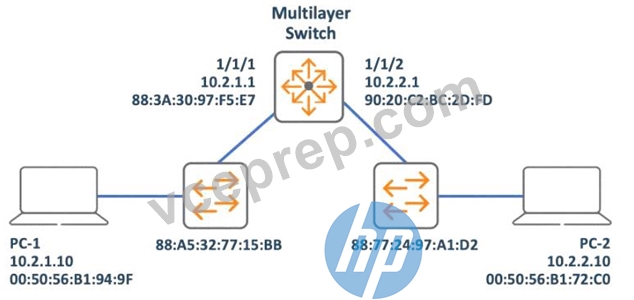
PC-1 is sending a packet to PC-2. What are the Layer 2 and Layer 3 source addresses of the message when it is received by PC-2? (Select two.)
- A. source MAC is 90:20:C2:BC:2D:FD
- B. source MAC is 00:50:56:B1:94:9F
- C. source IP is 10.2.2.1
- D. destination MAC is 88:77:24:97:A1:D2
- E. source IP is 10.2.1.10
Answer: A,E
Explanation:
Explanation
In the given network diagram, PC-1 is sending a packet to PC-2. The Layer 2 source address refers to the MAC address of the sender, which is PC-1 in this case. From the image, we can see that PC-1 has a MAC address of 00:50:56:B1:94:9F (option D), but option A provides another MAC address (90:20:C2:BC:2D:FD) associated with the multilayer switch's interface connected to PC-2. Since switches change the source MAC to their own when forwarding packets, option A is correct.
The Layer 3 source address refers to the IP address of the sender (PC-1). From the image, it's clear that PC-1 has an IP address of 10.2.1.10 (option C).
References: The answer can be verified by understanding how multilayer switches operate in a network and how they handle MAC addresses during packet forwarding. You can find more information about this topic in the following resources:
* Aruba Certified Network Technician (ACNT) | HPE Aruba Networking
* Education Services | HPE Aruba Networking
* Aruba Certified Network Technician University Promotion
NEW QUESTION # 32
Why do clients run the Address Resolution Protocol (ARP)?
- A. To discover the source address of the Layer z header that encapsulates IP packets.
- B. To discover the source address of the Layer 3 header of IP packets.
- C. To discover the destination address of the Layer z header that encapsulates IP packets.
- D. To discover the destination address of the Layer 3 header of IP packets.
Answer: C
Explanation:
Explanation
ARP is a protocol that maps an IP address to a MAC address, which is the physical address of a device on a network. ARP is necessary because the software address (IP address) of the host or computer connected to the network needs to be translated to a hardware address (MAC address). Without ARP, a host would not be able to figure out the hardware address of another host. ARP works by sending a broadcast message to all devices on the network, asking for the MAC address of the device that has a specific IP address. The device that has that IP address replies with its MAC address, and the sender stores this information in its ARP cache for future use. The sender then uses the MAC address as the destination address of the Layer 2 header that encapsulates the IP packet. The Layer 2 header is also known as the data link layer header, which is responsible for delivering the packet to the correct device on the same network. The Layer 3 header is also known as the network layer header, which is responsible for routing the packet to the correct network. Therefore, the correct answer is C, because ARP is used to discover the destination address of the Layer 2 header that encapsulates IP packets1234 References: What Is Address Resolution Protocol (ARP)? - Fortinet, Address Resolution Protocol - Wikipedia, ARP (Address Resolution Protocol) explained - Study-CCNA, Aruba Certified Network Technician Exam HPE3-U01 Actual Questions
NEW QUESTION # 33
How many addresses does the 255.255.252.0 provide?
- A. 0
- B. 1
- C. 2
- D. 3
Answer: B
Explanation:
Explanation
The subnet mask 255.255.252.0 is equivalent to the CIDR notation /22, which means that 22 bits are used for the network prefix and 10 bits are used for the host part. To calculate the number of addresses that this subnet mask provides, we can use the formula2n2, wherenis the number of bits in the host part. In this case,n=10, so the number of addresses is2102=10242=1022. The subtraction of 2 is because the first and the last addresses are reserved for the network identifier and the broadcast address, respectively. Therefore, the subnet mask
255.255.252.0 provides 1022 usable addresses for hosts, plus 2 reserved addresses, for a total of 1024 addresses.References:IP Subnet Calculator,How many host addresses are available on the network ... - ITExamAnswers
NEW QUESTION # 34
Which message is an example of Broadcast communication?
- A. DHCP offer
- B. ARP Request
- C. ICMP echo
- D. HTTP Get
Answer: B
Explanation:
Explanation
Broadcast communication is the distribution of audio or video content to a dispersed audience via any electronic mass communications medium, using the electromagnetic spectrum (radio waves), in a one-to-many model1. A broadcast message is a message that is sent to all endpoints on the network, regardless of their address or identity2. An example of a broadcast message is an ARP request, which is used to find the MAC address of a device that has a specific IP address3. An ARP request is sent to the broadcast address of the network, which is usually the last address in the subnet (e.g., 192.168.1.255 for a /24 network). All devices on the network receive the ARP request and check if their IP address matches the one in the request. If so, they reply with their MAC address to the sender of the ARP request. If not, they ignore the request4. Therefore, an ARP request is an example of broadcast communication, while the other options are not. A DHCP offer is a message that is sent by a DHCP server to a specific client that requested an IP address5. An ICMP echo is a message that is sent by a device to test the connectivity and latency to another device. An HTTP Get is a message that is sent by a web browser to request a web page from a web server. These messages are not broadcast, but rather unicast, meaning they are sent to a single destination. References: 1: Broadcasting - Wikipedia 2: Broadcast communication network - Wikipedia 3: [Address Resolution Protocol - Wikipedia] 4:
[How ARP Works - Cisco] 5: [DHCP - Wikipedia] : [Ping (networking utility) - Wikipedia] : [Hypertext Transfer Protocol - Wikipedia] : https://en.wikipedia.org/wiki/Address_Resolution_Protocol :
https://www.cisco.com/c/en/us/support/docs/ip/dynamic-address-allocation-resolution/13718-5.html :
https://en.wikipedia.org/wiki/Dynamic_Host_Configuration_Protocol :
https://en.wikipedia.org/wiki/Ping_(networking_utility) :
https://en.wikipedia.org/wiki/Hypertext_Transfer_Protocol
NEW QUESTION # 35
......
HPE3-U01 Study Material, Preparation Guide and PDF Download: https://www.vceprep.com/HPE3-U01-latest-vce-prep.html
HPE3-U01 Actual Questions 100% Same Braindumps with Actual Exam: https://drive.google.com/open?id=16UDeWzt2Gtqod78ipSR2HCm79RoMMQWa