


Accurate Hot Selling CTAL_TM_001 Exam Dumps 2024 Newly Released
Get 100% Authentic ISQI CTAL_TM_001 Dumps with Correct Answers
CTAL-TM Certification Path
6 months of experience in Software development/software testing. Successful completion of the ISTQB Certified Tester Foundation level and a minimum of three years testing experience is recommended. The Intermediate Certificate may also be helpful but is not required.
Topics of CTAL-TM Exam
Candidates must know the exam topics before they start of preparation. Because it will really help them in hitting the core. Our CTAL-TM exam dumps will include the following topics:
1. Testing Process
- test analysis and design
- Evaluating exit criteria and reporting.
- Test planning, monitoring and control.
- Test implementation and execution.
- Test closure activities
2. Test Management
- Managing the application to industry standards.
- Distributed outsourced and insourced testing.
- Test estimation and test metrics.
- Business value of testing.
- Test documentation.
3. Reviews
- Managing formal reviews.
- Management reviews and audits.
- Metrics for reviews.
- Managing reviews.
4. Defect Management
- Accessing process capability with defect report.
- Defect lifecycle.
- Defect report information.
5. Improving the testing process
- Improving the testing process with CMMi, TPI, CTP, STEP.
- Test improvement process.
6. Test tool and automation
- Tool lifecycle
- Tool metrics
- Tool selection
7. People skills
- Fitting testing within an organization.
- Individual skills.
- Motivation.
- Test team and dynamics.
- Communication.
NEW QUESTION # 23
Which of the following is a typical use of risk analysis? [1]
- A. Identifying the appropriate depth of testing for each identified risk
- B. Deciding what personnel should be assigned to which tests
- C. Forecasting the product delivery date
- D. Determining the design of the tests used to mitigate each identified risk
Answer: A
Explanation:
Risk analysis is typically used to identify the appropriate depth of testing for each identified risk. This involves assessing the potential impact and likelihood of risks to prioritize testing efforts and ensure that high-risk areas are thoroughly tested.
References:The ISTQB Advanced Level Test Manager syllabus and e-learning materials emphasize the importance of organizing and leading risk identification and risk analysis sessions. The outcomes of these sessions are used for test estimation, planning, monitoring, and control, which includes determining the depth of testing based on the identified risks
NEW QUESTION # 24
You have investigated different possibilities and selected four of them to present to IT management. Which of the proposals will you most likely give your highest recommendations? 3 credits
- A. Outsourcing of test automation based on an offer from an Asian company, AsiaAutoTest, which has people who are specialists in system level capture-replay automation tools. They also offer training and besides they offer to run and maintain the regression tests in the future.
- B. Internal offer from the development department of XYZ to create the regression package using CppUnit as test automation tool. One of the development groups have very good experiences in automating unit tests, and they are willing to do training as well.
- C. Insourcing of test automation based on an offer from a local company ABC that has people who are specialists in system level capture-replay automation tools and they also do regular training courses in test automation methods and tools. They can then work closely with Vicki.
- D. Solution from a tool vendor offering to educate two test team members in the use of their easy-to-use test automation capture replay tool over the first 3 month and based on that build the regression test suite. In addition to Vicki, Steve is the only one that has time available to be educated.
Answer: C
NEW QUESTION # 25
Risks should be constantly reviewed. Given the current situation, which one of the following factors is most likely to lead to a revised view of product risk? 3 credits
- A. The delivery of the application without the interface changes may upset the user community.
- B. The concerns over the user interface may lead to changes to the interface which cannot be implemented by development in time for the second test iteration.
- C. The concerns over the user interface raises the likelihood of a risk in that area and increases the amount of test effort needed for the user interface, thereby limiting the test effort available for other parts of the test management tool.
- D. The method used for test estimation is not accurate enough and hence the money spent on testing exceeded its budget.
Answer: C
NEW QUESTION # 26
Relying only on the information provided in the scenario, select the TWO items and/or features for which sufficient information is available to proceed with test design. 2 credits
- A. All supported credit cards
- B. Usability
- C. Response time
- D. Language localization
- E. Valid and invalid advances
Answer: A,E
Explanation:
Explanation/Reference:
Explanation:
NEW QUESTION # 27
Continuing with the Scenario described in the previous question, which of the following topics would you need to address in detail in the master test plan? 3 credits
- A. A description of dependencies between test cases
- B. A list of boundary values for "advance amount"
- C. A logical collection of test cases
- D. An approach to regression testing
Answer: D
Explanation:
Explanation/Reference:
Explanation:
NEW QUESTION # 28
In addition to risk, identify TWO other components of a testing strategy. 1 credit
- A. The entry and exit criteria for each test phase
- B. Test training needs for the project resources
- C. The test design techniques to be used
- D. Test performance indicators
- E. The test schedule
Answer: A,C
Explanation:
Explanation/Reference:
Explanation:
NEW QUESTION # 29
Which of the following team roles would be most appropriate to enhance the team and why? 2 credits
- A. A person with the ability to complete tasks
- B. A quality assurance officer
- C. A person who brings new ideas to the team
- D. A person with in-depth technical skills
Answer: C
NEW QUESTION # 30
Which of the following would you expect to see in the master test plan? 1 credit
- A. A detailed identification of the resources that will carry out structural testing in the first iteration.
- B. A list of the names of the testers who will carry out the performance testing for the final iteration.
- C. A description of how the test cases are cross-referenced to requirements in the test management tool.
- D. The test approach that will be applied at system integration testing.
Answer: D
NEW QUESTION # 31
Which of the following statements is true regarding documentation standards? [2]
- A. Documentation standards can vary depending on the test level.
- B. Agile projects consistently use level test plans and documentation standards.
- C. Documentation standards are a lower priority than testing standards.
- D. Documentation standards are determined by the Project Manager.
Answer: A
Explanation:
Documentation standards are not uniform across all test levels; they can differ based on the specific requirements of each level. For instance, unit testing may have different documentation needs compared to system testing. The ISTQB documentation standards recognize this variability and allow for flexibility to suit the context of the test level. This ensures that the documentation is appropriate for the objectives and constraints of each test level, providing clarity and efficiency in the testing process.
References: The ISTQB Advanced Level Test Manager syllabus and the ISTQB Glossary provide detailed information on documentation standards and their application across different test levels. These resources are essential for understanding the principles and practices of effective test documentation in various testing scenarios.
NEW QUESTION # 32
You have just conducted a skills assessment for your team. You decided to rate everyone from 1 to 5 in the skill areas as follows:
5 = expert
4 = proficient
3 = can use this skill effectively but will need some assistance
2 = interested in learning this skill but has only minimal knowledge
1 = not interested in learning this skill
Given these values, you have rated your team as shown in the table below for the designated skill areas: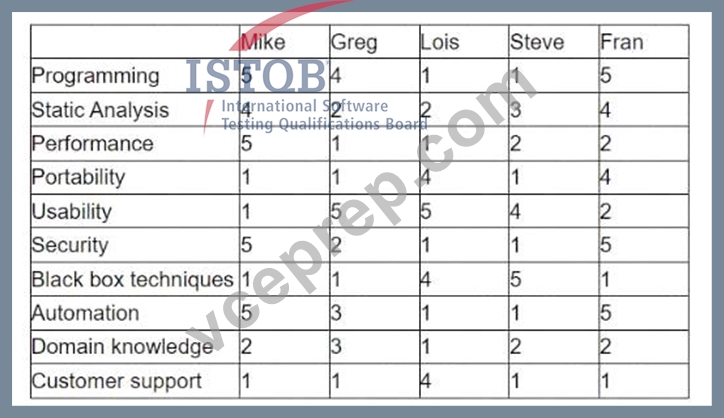
You will be starting to test a new product that is an upgrade from one of your existing end user products. Your testing will include white box, performance, security, usability, and black box. You also have a goal to automate 100% of the smoke test and
50% of the regression tests by the end of the release.
Your team willingly shares knowledge and conducts regular lunch time cross-training sessions.
Your manager wants to know if you would like to bring in someone to help train your team in preparation for this project. In which area could you best utilize this help? [3]
- A. Training in automation
- B. Training in black box techniques
- C. Training in domain knowledge
- D. Training in customer support
Answer: A
Explanation:
Based on the table, the area where your team could best utilize help is training in automation. This is because most of your team members are either not interested in learning this skill or have only minimal knowledge about it. Automation is an important skill for testing, especially for achieving your goal of automating the smoke test and the regression test. Training in automation can help your team to learn how to use various tools and frameworks to create, execute, and maintain automated test scripts. Training in automation can also improve the efficiency, effectiveness, and coverage of your testing process. Best Automation Courses & Certificates OnlineTraining - ISATop Automation Courses Online References:
* Best Automation Courses & Certificates Online
* Training - ISA
* Top Automation Courses Online
NEW QUESTION # 33
You have been carefully monitoring the progress of testing for your project. You have been using the established traceability to verify that the requirements and test conditions are being adequately addressed. The test team is proceeding well in their test case execution and you can see that you are achieving about 80% coverage of the test conditions per the traceability mapping in your test management system. You have seen a number of defects being logged against test conditions that are failing, but you do not see a mapping of the test cases to those conditions.
What is likely to be occurring in the testing area that is causing the traceability to break down? [2]
- A. The test cases are mapped to the test strategy and are bypassing the test conditions.
- B. The testers are executing the wrong tests.
- C. The testers are not updating the test execution information in the test management system.
- D. The testers are running exploratory tests that are not mapped to the test conditions.
Answer: C
Explanation:
The most likely cause of the traceability breakdown in the testing area is that the testers are not updating the test execution information in the test management system. This is because the test management system is a tool that supports the test process, and it can store and manage the test documentation, such as the requirements, the test conditions, the test cases, and the test results. If the testers do not update the test execution information in the test management system, such as the test cases that are run, the test results that are obtained, and the defects that are found, the traceability between the test cases and the test conditions will be lost or inaccurate. This can affect the test analysis and reporting, and the test coverage measurement. Test Management - ISTQB not-for-profit association References: Certified Tester Advanced Level Test Manager (CTAL-TM) - ISTQB not-for-profit association, ISTQB Test Manager Certification - ISTQB Exams Worldwide - ISTQB Official Registration, Test Management - ISTQB not-for-profit association
NEW QUESTION # 34
Evaluate the status of the project against the defined exit criteria. Which of the following options shows the correct status? 2 credits
- A. Criteria A = OK, criteria B = OK, criteria C = OK
- B. Criteria A = NOT OK, criteria B = NOT OK, criteria C = OK
- C. Criteria A = NOT OK, criteria B = NOT OK, criteria C = NOT OK
- D. Criteria A = OK, criteria B = NOT OK, criteria C = NOT OK
Answer: B
Explanation:
Explanation/Reference:
Explanation:
NEW QUESTION # 35
IEEE 1028 also defines "management review" as a type of review. What is the main purpose of a management review? 1 credit
- A. Provide independent evaluation of compliance to processes, regulations, standards etc.
- B. Align technical concepts during the design phase
- C. To monitor progress, assess the status of a project, and make decisions about future actions
- D. Establish a common understanding of requirements
Answer: C
Explanation:
Explanation/Reference:
Explanation:
NEW QUESTION # 36
Which of the following is a benefit of independent testing? 1 credit
- A. Testing is isolated from development.
- B. Developers do not have to take as much responsibility for quality.
- C. Independent testers find different defects and are unbiased.
- D. Code cannot be released into production until independent testing is complete.
Answer: C
NEW QUESTION # 37
What is the primary use for the traceability information regarding the relationship between test results and test conditions during test execution? [2]
- A. The tester uses this information to determine which test should be run next.
- B. The Test Manager uses this information to control the test execution effort.
- C. The development manager uses this information to determine how many developer resources to allocate to defect repair.
- D. The project manager uses this information to determine if the project is on schedule.
Answer: B
Explanation:
The correct answer is A. The Test Manager uses this information to control the test execution effort. This is because traceability information regarding the relationship between test results and test conditions can help the Test Manager to measure and evaluate the test progress, quality, and coverage, and to take corrective actions when necessary. For example, the Test Manager can use this information to identify and prioritize the test conditions that have not been tested yet, to analyze the test results and the defect status, and to adjust the test execution plan and schedule accordingly. Test Monitoring and Control - ISTQB not-for-profit association References: Certified Tester Advanced Level Test Manager (CTAL-TM) - ISTQB not-for-profit association, ISTQB Test Manager Certification - ISTQB Exams Worldwide - ISTQB Official Registration, Test Monitoring and Control - ISTQB not-for-profit association
NEW QUESTION # 38
A test log is one of the documents that need to be produced in this domain in order to provide evidence of testing. However, the level of detail of test logs can vary. Which of the following is NOT an influencing factor for the level of detail of the test logs being produced? 1 credit
- A. Test level
- B. Experience level of testers
- C. Level of test execution automation
- D. Regulatory requirements
Answer: B
Explanation:
Explanation/Reference:
Explanation:
NEW QUESTION # 39
......
How to book CTAL-TM Exams
In order to apply for the NET, You have to follow these steps
- Go to the CTAL-TM Official Site
- Read the instruction Carefully
- Follow the given steps
- Apply for the CTAL-TM
Dumps of CTAL_TM_001 Cover all the requirements of the Real Exam: https://www.vceprep.com/CTAL_TM_001-latest-vce-prep.html
New Training Course CTAL_TM_001 Tutorial Preparation Guide: https://drive.google.com/open?id=1vGWGdfUBdbAmY5om4uBcThJ8X5P2rqt6