


DP-420 Dumps Special Discount for limited time Try FOR FREE
DP-420 Dumps for success in Actual Exam Mar-2023]
Here is the easiest way to get prepared for the Microsoft DP-420 Certification Exam
You can get ready for taking the Microsoft DP-420 Certification Exam by following the steps mentioned here. You should always make a study plan for the Microsoft DP-420 Certification Exam. You should know the exam objectives and syllabus. The candidate should also know the previous question and answer of the DP-420 Certification Exam. You should prepare the questions and answers of the DP-420 Certification Exam by referring to the study materials. After that, you should always make a mock test for the Microsoft DP-420 Certification Exam. You should take a mock test before the actual exam.
You can also use DP-420 Dumps. It will help you to get a clear idea about your preparation. You should also take a mock test periodically. You should also compare your performance with other candidates. It will help you to get a clear idea about your preparation. In the end, you should practice the DP-420 Certification Exam by using the practice test software. It will help you to get a clear idea about your preparation. You should also practice the questions and answers of the DP-420 Certification Exam. You should try to solve the questions as soon as you finish reading the question.
NEW QUESTION 19
Note: This question is part of a series of questions that present the same scenario. Each question in the series contains a unique solution that might meet the stated goals. Some question sets might have more than one correct solution, while others might not have a correct solution.
After you answer a question in this section, you will NOT be able to return to it. As a result, these questions will not appear in the review screen.
You have a container named container1 in an Azure Cosmos DB Core (SQL) API account.
You need to make the contents of container1 available as reference data for an Azure Stream Analytics job.
Solution: You create an Azure Synapse pipeline that uses Azure Cosmos DB Core (SQL) API as the input and Azure Blob Storage as the output.
Does this meet the goal?
- A. Yes
- B. No
Answer: B
Explanation:
Instead create an Azure function that uses Azure Cosmos DB Core (SQL) API change feed as a trigger and Azure event hub as the output.
The Azure Cosmos DB change feed is a mechanism to get a continuous and incremental feed of records from an Azure Cosmos container as those records are being created or modified. Change feed support works by listening to container for any changes. It then outputs the sorted list of documents that were changed in the order in which they were modified.
The following diagram represents the data flow and components involved in the solution:
NEW QUESTION 20
You have a container in an Azure Cosmos DB Core (SQL) API account.
You need to use the Azure Cosmos DB SDK to replace a document by using optimistic concurrency.
What should you include in the code? To answer, select the appropriate options in the answer area.
NOTE: Each correct selection is worth one point.
Answer:
Explanation:
Reference:
https://docs.microsoft.com/en-us/dotnet/api/microsoft.azure.cosmos.itemrequestoptions
https://cosmosdb.github.io/labs/dotnet/labs/10-concurrency-control.html
NEW QUESTION 21
You have a container named container1 in an Azure Cosmos DB Core (SQL) API account.
The following is a sample of a document in container1.
{
"studentId": "631282",
"firstName": "James",
"lastName": "Smith",
"enrollmentYear": 1990,
"isActivelyEnrolled": true,
"address": {
"street": "",
"city": "",
"stateProvince": "",
"postal": "",
}
}
The container1 container has the following indexing policy.
{
"indexingMode": "consistent",
"includePaths": [
{
"path": "/*"
},
{
"path": "/address/city/?"
}
],
"excludePaths": [
{
"path": "/address/*"
},
{
"path": "/firstName/?"
}
]
}
For each of the following statements, select Yes if the statement is true. Otherwise, select No.
NOTE: Each correct selection is worth one point.
Answer:
Explanation:
NEW QUESTION 22
The settings for a container in an Azure Cosmos DB Core (SQL) API account are configured as shown in the following exhibit.
Which statement describes the configuration of the container?
- A. Items stored in the collection will expire only if the item has a time to live value.
- B. All items will be deleted after one year.
- C. All items will be deleted after one hour.
- D. Items stored in the collection will be retained always, regardless of the items time to live value.
Answer: A
Explanation:
When DefaultTimeToLive is -1 then your Time to Live setting is On (No default) Time to Live on a container, if present and the value is set to "-1", it is equal to infinity, and items don't expire by default.
Time to Live on an item:
This Property is applicable only if DefaultTimeToLive is present and it is not set to null for the parent container.
If present, it overrides the DefaultTimeToLive value of the parent container.
NEW QUESTION 23
You have an Azure Cosmos DB Core (SQL) API account that is configured for multi-region writes. The account contains a database that has two containers named container1 and container2.
The following is a sample of a document in container1:
{
"customerId": 1234,
"firstName": "John",
"lastName": "Smith",
"policyYear": 2021
}
The following is a sample of a document in container2:
{
"gpsId": 1234,
"latitude": 38.8951,
"longitude": -77.0364
}
You need to configure conflict resolution to meet the following requirements:
For container1 you must resolve conflicts by using the highest value for policyYear.
For container2 you must resolve conflicts by accepting the distance closest to latitude: 40.730610 and longitude: -73.935242.
Administrative effort must be minimized to implement the solution.
What should you configure for each container? To answer, drag the appropriate configurations to the correct containers. Each configuration may be used once, more than once, or not at all. You may need to drag the split bar between panes or scroll to view content.
NOTE: Each correct selection is worth one point.
Answer:
Explanation:
Reference:
https://docs.microsoft.com/en-us/azure/cosmos-db/conflict-resolution-policies
https://docs.microsoft.com/en-us/azure/cosmos-db/sql/how-to-manage-conflicts
NEW QUESTION 24
You have the following query.
SELECT * FROM c
WHERE c.sensor = "TEMP1"
AND c.value < 22
AND c.timestamp >= 1619146031231
You need to recommend a composite index strategy that will minimize the request units (RUs) consumed by the query.
What should you recommend?
- A. a composite index for (sensor ASC, value ASC, timestamp ASC) and a composite index for (sensor DESC, value DESC, timestamp DESC)
- B. a composite index for (value ASC, sensor ASC) and a composite index for (timestamp ASC, sensor ASC)
- C. a composite index for (sensor ASC, value ASC) and a composite index for (sensor ASC, timestamp ASC)
- D. a composite index for (sensor ASC, value ASC, timestamp ASC)
Answer: C
Explanation:
If a query has a filter with two or more properties, adding a composite index will improve performance.
Consider the following query:
SELECT * FROM c WHERE c.name = "Tim" and c.age > 18
In the absence of a composite index on (name ASC, and age ASC), we will utilize a range index for this query. We can improve the efficiency of this query by creating a composite index for name and age.
Queries with multiple equality filters and a maximum of one range filter (such as >,<, <=, >=, !=) will utilize the composite index.
NEW QUESTION 25
You have a database in an Azure Cosmos DB Core (SQL) API account.
You need to create an Azure function that will access the database to retrieve records based on a variable named accountnumber. The solution must protect against SQL injection attacks.
How should you define the command statement in the function?
- A. cmd = "SELECT * FROM Persons p
WHERE p.accountnumber = 'accountnumber'" - B. cmd = "SELECT * FROM Persons p
WHERE p.accountnumber = '" + accountnumber + "'" - C. cmd = "SELECT * FROM Persons p
WHERE p.accountnumber = LIKE @accountnumber" - D. cmd = "SELECT * FROM Persons p
WHERE p.accountnumber = @accountnumber"
Answer: D
Explanation:
Azure Cosmos DB supports queries with parameters expressed by the familiar @ notation. Parameterized SQL provides robust handling and escaping of user input, and prevents accidental exposure of data through SQL injection.
For example, you can write a query that takes lastName and address.state as parameters, and execute it for various values of lastName and address.state based on user input.
SELECT *
FROM Families f
WHERE f.lastName = @lastName AND f.address.state = @addressState
NEW QUESTION 26
You provision Azure resources by using the following Azure Resource Manager (ARM) template.
For each of the following statements, select Yes if the statement is true. Otherwise, select No.
NOTE: Each correct selection is worth one point.
Answer:
Explanation:
NEW QUESTION 27
You plan to deploy two Azure Cosmos DB Core (SQL) API accounts that will each contain a single database. The accounts will be configured as shown in the following table.
How should you provision the containers within each account to minimize costs? To answer, select the appropriate options in the answer area.
NOTE: Each correct selection is worth one point.
Answer:
Explanation:
Reference:
https://docs.microsoft.com/en-us/azure/cosmos-db/serverless
https://docs.microsoft.com/en-us/azure/cosmos-db/provision-throughput-autoscale#use-cases-of-autoscale
NEW QUESTION 28
You configure Azure Cognitive Search to index a container in an Azure Cosmos DB Core (SQL) API account as shown in the following exhibit.
Use the drop-down menus to select the answer choice that completes each statement based on the information presented in the graphic.
NOTE: Each correct selection is worth one point.
Answer:
Explanation:
NEW QUESTION 29
You have an Azure Cosmos DB Core (SQL) API account.
You configure the diagnostic settings to send all log information to a Log Analytics workspace.
You need to identify when the provisioned request units per second (RU/s) for resources within the account were modified.
You write the following query.
AzureDiagnostics
| where Category == "ControlPlaneRequests"
What should you include in the query?
- A. | where OperationName startswith "AccountUpdateStart"
- B. | where OperationName startswith "SqlContainersDelete"
- C. | where OperationName startswith "MongoCollectionsThroughputUpdate"
- D. | where OperationName startswith "SqlContainersThroughputUpdate"
Answer: A
Explanation:
The following are the operation names in diagnostic logs for different operations:
RegionAddStart, RegionAddComplete
RegionRemoveStart, RegionRemoveComplete
AccountDeleteStart, AccountDeleteComplete
RegionFailoverStart, RegionFailoverComplete
AccountCreateStart, AccountCreateComplete
*AccountUpdateStart*, AccountUpdateComplete
VirtualNetworkDeleteStart, VirtualNetworkDeleteComplete
DiagnosticLogUpdateStart, DiagnosticLogUpdateComplete
NEW QUESTION 30
You have an Azure Cosmos DB Core (SQL) API account named storage1 that uses provisioned throughput capacity mode.
The storage1 account contains the databases shown in the following table.
The databases contain the containers shown in the following table.
For each of the following statements, select Yes if the statement is true. Otherwise, select No.
NOTE: Each correct selection is worth one point.
Answer:
Explanation:
Reference:
https://docs.microsoft.com/en-us/azure/cosmos-db/plan-manage-costs
https://azure.microsoft.com/en-us/pricing/details/cosmos-db/
NEW QUESTION 31
You have an Azure Cosmos DB Core (SQL) API account used by an application named App1.
You open the Insights pane for the account and see the following chart.
Use the drop-down menus to select the answer choice that answers each question based on the information presented in the graphic.
NOTE: Each correct selection is worth one point.
Answer:
Explanation:
NEW QUESTION 32
You are implementing an Azure Data Factory data flow that will use an Azure Cosmos DB (SQL API) sink to write a dataset. The data flow will use 2,000 Apache Spark partitions.
You need to ensure that the ingestion from each Spark partition is balanced to optimize throughput.
Which sink setting should you configure?
- A. Batch size
- B. Throughput
- C. Write throughput budget
- D. Collection action
Answer: A
Explanation:
Batch size: An integer that represents how many objects are being written to Cosmos DB collection in each batch. Usually, starting with the default batch size is sufficient. To further tune this value, note:
Cosmos DB limits single request's size to 2MB. The formula is "Request Size = Single Document Size * Batch Size". If you hit error saying "Request size is too large", reduce the batch size value.
The larger the batch size, the better throughput the service can achieve, while make sure you allocate enough RUs to empower your workload.
Incorrect Answers:
A: Throughput: Set an optional value for the number of RUs you'd like to apply to your CosmosDB collection for each execution of this data flow. Minimum is 400.
B: Write throughput budget: An integer that represents the RUs you want to allocate for this Data Flow write operation, out of the total throughput allocated to the collection.
D: Collection action: Determines whether to recreate the destination collection prior to writing.
None: No action will be done to the collection.
Recreate: The collection will get dropped and recreated
NEW QUESTION 33
You have an Azure Cosmos DB Core (SQL) API account named account1.
In account1, you run the following query in a container that contains 100GB of data.
SELECT *
FROM c
WHERE LOWER(c.categoryid) = "hockey"
You view the following metrics while performing the query.
For each of the following statements, select Yes if the statement is true. Otherwise, select No.
NOTE: Each correct selection is worth one point.
Answer:
Explanation:
NEW QUESTION 34
You need to provide a solution for the Azure Functions notifications following updates to con-product. The solution must meet the business requirements and the product catalog requirements.
Which two actions should you perform? Each correct answer presents part of the solution.
NOTE: Each correct selection is worth one point.
- A. Configure the trigger for each function to use a different leaseCollectionPrefix
- B. Configure the trigger for each function to use the same leaseCollectionPrefix
- C. Configure the trigger for each function to use the same leaseCollectionNair.e
- D. Configure the trigger for each function to use a different leaseCollectionName
Answer: A,C
Explanation:
leaseCollectionPrefix: when set, the value is added as a prefix to the leases created in the Lease collection for this Function. Using a prefix allows two separate Azure Functions to share the same Lease collection by using different prefixes.
Scenario: Use Azure Functions to send notifications about product updates to different recipients.
Trigger the execution of two Azure functions following every update to any document in the con-product container.
Reference:
https://docs.microsoft.com/en-us/azure/azure-functions/functions-bindings-cosmosdb-v2-trigger
NEW QUESTION 35
The following is a sample of a document in orders.
The orders container uses customerId as the partition key.
You need to provide a report of the total items ordered per month by item type. The solution must meet the following requirements:
Ensure that the report can run as quickly as possible.
Minimize the consumption of request units (RUs).
What should you do?
- A. Configure the report to query orders by using a SQL query.
- B. Configure the report to query a new aggregate container. Populate the aggregates by using the change feed.
- C. Configure the report to query a new aggregate container. Populate the aggregates by using SQL queries that run daily.
- D. Configure the report to query orders by using a SQL query through a dedicated gateway.
Answer: B
Explanation:
You can facilitate aggregate data by using Change Feed and Azure Functions, and then use it for reporting.
NEW QUESTION 36
You have a container named container1 in an Azure Cosmos DB Core (SQL) API account. The container1 container has 120 GB of data.
The following is a sample of a document in container1.
The orderId property is used as the partition key.
For each of the following statements, select Yes if the statement is true. Otherwise, select No.
NOTE: Each correct selection is worth one point.
Answer:
Explanation: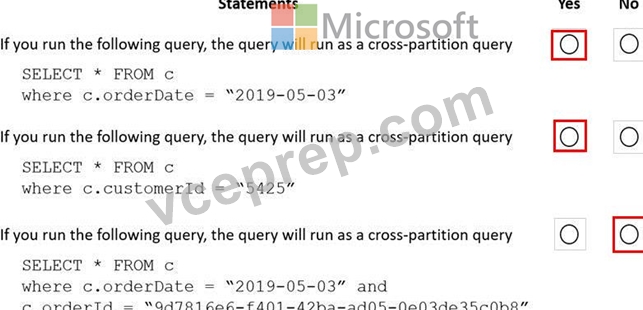
NEW QUESTION 37
You have a database named telemetry in an Azure Cosmos DB Core (SQL) API account that stores IoT dat a. The database contains two containers named readings and devices.
Documents in readings have the following structure.
id
deviceid
timestamp
ownerid
measures (array)
- type
- value
- metricid
Documents in devices have the following structure.
id
deviceid
owner
- ownerid
- emailaddress
- name
brand
model
For each of the following statements, select Yes if the statement is true. Otherwise, select No.
NOTE: Each correct selection is worth one point.
Answer:
Explanation:
NEW QUESTION 38
......
Accurate DP-420 Answers 365 Days Free Updates: https://www.vceprep.com/DP-420-latest-vce-prep.html
Realistic DP-420 100% Pass Guaranteed Download Exam Q&A: https://drive.google.com/open?id=1OuGEcqXi1J91h8AdOcXZrPg-Og6m_17n