


Google Professional-Data-Engineer Certification Exam Dumps with 253 Practice Test Questions
New Professional-Data-Engineer Exam Dumps with High Passing Rate
Data Engineering on Google Cloud course
It is a 4-day course that gives hands-on experience to the candidates and allows them to build data processing systems on Google Cloud. It will also show you how to design data processing systems, analyze data and build end-to-end data pipelines and machine learning. In order to get a better understanding of the course, you need to complete the big data machine learning course or get equivalent experience. This course also aids you in developing applications using a programming language such as Python and covers the following objective:
- Predicting machine models using TensorFlow and Cloud ML
- Influencing unstructured data using ML APIs on Cloud Dataproc
- Designing and building data processing systems on the Google Cloud Platform
- Processing batch and streaming data by using autoscaling data pipelines on Cloud Dataflow
- Enable insights from streaming data
Google Professional Data Engineer Certified Professional salary
The average salary of a Google Professional Data Engineer Certified Expert in
- India - 25,42,327 INR
- England - 115,632 POUND
- Europe - 135,347 EURO
- United State - 151,247 USD
NEW QUESTION 39
You are designing storage for two relational tables that are part of a 10-TB database on Google Cloud. You want to support transactions that scale horizontally. You also want to optimize data for range queries on non- key columns. What should you do?
- A. Use Cloud Spanner for storage. Add secondary indexes to support query patterns.
- B. Use Cloud SQL for storage. Add secondary indexes to support query patterns.
- C. Use Cloud Spanner for storage. Use Cloud Dataflow to transform data to support query patterns.
- D. Use Cloud SQL for storage. Use Cloud Dataflow to transform data to support query patterns.
Answer: C
Explanation:
Explanation/Reference: https://cloud.google.com/solutions/data-lifecycle-cloud-platform
NEW QUESTION 40
After migrating ETL jobs to run on BigQuery, you need to verify that the output of the migrated jobs is the same as the output of the original. You've loaded a table containing the output of the original job and want to compare the contents with output from the migrated job to show that they are identical. The tables do not contain a primary key column that would enable you to join them together for comparison.
What should you do?
- A. Create stratified random samples using the OVER() function and compare equivalent samples from each table.
- B. Select random samples from the tables using the HASH() function and compare the samples.
- C. Select random samples from the tables using the RAND() function and compare the samples.
- D. Use a Dataproc cluster and the BigQuery Hadoop connector to read the data from each table and calculate a hash from non-timestamp columns of the table after sorting. Compare the hashes of each table.
Answer: B
NEW QUESTION 41
You are designing a basket abandonment system for an ecommerce company. The system will send a message to a user based on these rules:
No interaction by the user on the site for 1 hour
Has added more than $30 worth of products to the basket
Has not completed a transaction
You use Google Cloud Dataflow to process the data and decide if a message should be sent. How should you design the pipeline?
- A. Use a sliding time window with a duration of 60 minutes.
- B. Use a session window with a gap time duration of 60 minutes.
- C. Use a global window with a time based trigger with a delay of 60 minutes.
- D. Use a fixed-time window with a duration of 60 minutes.
Answer: C
NEW QUESTION 42
Your company is using WHILECARD tables to query data across multiple tables with similar names. The SQL statement is currently failing with the following error:
# Syntax error : Expected end of statement but got "-" at [4:11] SELECT age FROM bigquery-public-data.noaa_gsod.gsod WHERE age != 99 AND_TABLE_SUFFIX = `1929' ORDER BY age DESC Which table name will make the SQL statement work correctly?
- A. bigquery-public-data.noaa_gsod.gsod*
- B. `bigquery-public-data.noaa_gsod.gsod'*
- C. `bigquery-public-data.noaa_gsod.gsod*`
- D. `bigquery-public-data.noaa_gsod.gsod`
Answer: C
Explanation:
It follows the correct wildcard syntax of enclosing the table name in backticks and including the * wildcard character.
NEW QUESTION 43
MJTelco Case Study
Company Overview
MJTelco is a startup that plans to build networks in rapidly growing, underserved markets around the world.
The company has patents for innovative optical communications hardware. Based on these patents, they can create many reliable, high-speed backbone links with inexpensive hardware.
Company Background
Founded by experienced telecom executives, MJTelco uses technologies originally developed to overcome communications challenges in space. Fundamental to their operation, they need to create a distributed data infrastructure that drives real-time analysis and incorporates machine learning to continuously optimize their topologies. Because their hardware is inexpensive, they plan to overdeploy the network allowing them to account for the impact of dynamic regional politics on location availability and cost.
Their management and operations teams are situated all around the globe creating many-to-many relationship between data consumers and provides in their system. After careful consideration, they decided public cloud is the perfect environment to support their needs.
Solution Concept
MJTelco is running a successful proof-of-concept (PoC) project in its labs. They have two primary needs:
* Scale and harden their PoC to support significantly more data flows generated when they ramp to more than 50,000 installations.
* Refine their machine-learning cycles to verify and improve the dynamic models they use to control topology definition.
MJTelco will also use three separate operating environments - development/test, staging, and production - to meet the needs of running experiments, deploying new features, and serving production customers.
Business Requirements
* Scale up their production environment with minimal cost, instantiating resources when and where needed in an unpredictable, distributed telecom user community.
* Ensure security of their proprietary data to protect their leading-edge machine learning and analysis.
* Provide reliable and timely access to data for analysis from distributed research workers
* Maintain isolated environments that support rapid iteration of their machine-learning models without affecting their customers.
Technical Requirements
Ensure secure and efficient transport and storage of telemetry data
Rapidly scale instances to support between 10,000 and 100,000 data providers with multiple flows each.
Allow analysis and presentation against data tables tracking up to 2 years of data storing approximately 100m records/day Support rapid iteration of monitoring infrastructure focused on awareness of data pipeline problems both in telemetry flows and in production learning cycles.
CEO Statement
Our business model relies on our patents, analytics and dynamic machine learning. Our inexpensive hardware is organized to be highly reliable, which gives us cost advantages. We need to quickly stabilize our large distributed data pipelines to meet our reliability and capacity commitments.
CTO Statement
Our public cloud services must operate as advertised. We need resources that scale and keep our data secure.
We also need environments in which our data scientists can carefully study and quickly adapt our models.
Because we rely on automation to process our data, we also need our development and test environments to work as we iterate.
CFO Statement
The project is too large for us to maintain the hardware and software required for the data and analysis. Also, we cannot afford to staff an operations team to monitor so many data feeds, so we will rely on automation and infrastructure. Google Cloud's machine learning will allow our quantitative researchers to work on our high-value problems instead of problems with our data pipelines.
MJTelco's Google Cloud Dataflow pipeline is now ready to start receiving data from the 50,000 installations.
You want to allow Cloud Dataflow to scale its compute power up as required. Which Cloud Dataflow pipeline configuration setting should you update?
- A. The number of workers
- B. The maximum number of workers
- C. The disk size per worker
- D. The zone
Answer: D
NEW QUESTION 44
You are building a model to make clothing recommendations. You know a user's fashion preference is
likely to change over time, so you build a data pipeline to stream new data back to the model as it
becomes available. How should you use this data to train the model?
- A. Continuously retrain the model on just the new data.
- B. Continuously retrain the model on a combination of existing data and the new data.
- C. Train on the existing data while using the new data as your test set.
- D. Train on the new data while using the existing data as your test set.
Answer: D
NEW QUESTION 45
Which of the following statements about Legacy SQL and Standard SQL is not true?
- A. Standard SQL is the preferred query language for BigQuery.
- B. If you write a query in Legacy SQL, it might generate an error if you try to run it with Standard SQL.
- C. One difference between the two query languages is how you specify fully-qualified table names (i.e. table names that include their associated project name).
- D. You need to set a query language for each dataset and the default is Standard SQL.
Answer: D
Explanation:
You do not set a query language for each dataset. It is set each time you run a query and the default query language is Legacy SQL.
Standard SQL has been the preferred query language since BigQuery 2.0 was released.
In legacy SQL, to query a table with a project-qualified name, you use a colon, :, as a separator. In standard SQL, you use a period, ., instead.
Due to the differences in syntax between the two query languages (such as with project- qualified table names), if you write a query in Legacy SQL, it might generate an error if you try to run it with Standard SQL.
Reference:
https://cloud.google.com/bigquery/docs/reference/standard-sql/migrating-from-legacy-sql
NEW QUESTION 46
You create an important report for your large team in Google Data Studio 360. The report uses Google BigQuery as its data source. You notice that visualizations are not showing data that is less than 1 hour old.
What should you do?
- A. Refresh your browser tab showing the visualizations.
- B. Disable caching by editing the report settings.
- C. Clear your browser history for the past hour then reload the tab showing the virtualizations.
- D. Disable caching in BigQuery by editing table details.
Answer: B
Explanation:
Explanation/Reference: https://support.google.com/datastudio/answer/7020039?hl=en
NEW QUESTION 47
You operate an IoT pipeline built around Apache Kafka that normally receives around 5000 messages per second. You want to use Google Cloud Platform to create an alert as soon as the moving average over 1 hour drops below 4000 messages per second. What should you do?
- A. Consume the stream of data in Cloud Dataflow using Kafka IO. Set a sliding time window of 1 hour every 5 minutes. Compute the average when the window closes, and send an alert if the average is less than 4000 messages.
- B. Use Kafka Connect to link your Kafka message queue to Cloud Pub/Sub. Use a Cloud Dataflow template to write your messages from Cloud Pub/Sub to BigQuery. Use Cloud Scheduler to run a script every five minutes that counts the number of rows created in BigQuery in the last hour. If that number falls below
4000, send an alert. - C. Use Kafka Connect to link your Kafka message queue to Cloud Pub/Sub. Use a Cloud Dataflow template to write your messages from Cloud Pub/Sub to Cloud Bigtable. Use Cloud Scheduler to run a script every hour that counts the number of rows created in Cloud Bigtable in the last hour. If that number falls below
4000, send an alert. - D. Consume the stream of data in Cloud Dataflow using Kafka IO. Set a fixed time window of 1 hour. Compute the average when the window closes, and send an alert if the average is less than 4000 messages.
Answer: C
NEW QUESTION 48
You are selecting services to write and transform JSON messages from Cloud Pub/Sub to BigQuery for a data pipeline on Google Cloud. You want to minimize service costs. You also want to monitor and accommodate input data volume that will vary in size with minimal manual intervention. What should you do?
- A. Use Cloud Dataproc to run your transformations. Use the diagnosecommand to generate an operational output archive. Locate the bottleneck and adjust cluster resources.
- B. Use Cloud Dataflow to run your transformations. Monitor the job system lag with Stackdriver. Use the default autoscaling setting for worker instances.
- C. Use Cloud Dataflow to run your transformations. Monitor the total execution time for a sampling of jobs.
Configure the job to use non-default Compute Engine machine types when needed. - D. Use Cloud Dataproc to run your transformations. Monitor CPU utilization for the cluster. Resize the number of worker nodes in your cluster via the command line.
Answer: A
NEW QUESTION 49
You have a petabyte of analytics data and need to design a storage and processing platform for it. You must be able to perform data warehouse-style analytics on the data in Google Cloud and expose the dataset as files for batch analysis tools in other cloud providers. What should you do?
- A. Store and process the entire dataset in Cloud Bigtable.
- B. Store and process the entire dataset in BigQuery.
- C. Store the full dataset in BigQuery, and store a compressed copy of the data in a Cloud Storage bucket.
- D. Store the warm data as files in Cloud Storage, and store the active data in BigQuery. Keep this ratio as
80% warm and 20% active.
Answer: C
NEW QUESTION 50
Which of the following statements is NOT true regarding Bigtable access roles?
- A. To give a user access to only one table in a project, you must configure access through your application.
- B. You can configure access control only at the project level.
- C. To give a user access to only one table in a project, grant the user the Bigtable Editor role for that table.
- D. Using IAM roles, you cannot give a user access to only one table in a project, rather than all tables in a project.
Answer: C
Explanation:
For Cloud Bigtable, you can configure access control at the project level. For example, you can grant the ability to:
Read from, but not write to, any table within the project.
Read from and write to any table within the project, but not manage instances.
Read from and write to any table within the project, and manage instances.
Reference: https://cloud.google.com/bigtable/docs/access-control
NEW QUESTION 51
You work for a car manufacturer and have set up a data pipeline using Google Cloud Pub/Sub to capture
anomalous sensor events. You are using a push subscription in Cloud Pub/Sub that calls a custom HTTPS
endpoint that you have created to take action of these anomalous events as they occur. Your custom
HTTPS endpoint keeps getting an inordinate amount of duplicate messages. What is the most likely cause
of these duplicate messages?
- A. Your custom endpoint has an out-of-date SSL certificate.
- B. Your custom endpoint is not acknowledging messages within the acknowledgement deadline.
- C. The Cloud Pub/Sub topic has too many messages published to it.
- D. The message body for the sensor event is too large.
Answer: A
NEW QUESTION 52
You have spent a few days loading data from comma-separated values (CSV) files into the Google BigQuery table CLICK_STREAM. The column DT stores the epoch time of click events. For convenience, you chose a simple schema where every field is treated as the STRING type. Now, you want to compute web session durations of users who visit your site, and you want to change its data type to the TIMESTAMP. You want to minimize the migration effort without making future queries computationally expensive. What should you do?
- A. Add a column TS of the TIMESTAMP type to the table CLICK_STREAM, and populate the numeric values from the column TS for each row. Reference the column TS instead of the column DT from now on.
- B. Construct a query to return every row of the table CLICK_STREAM, while using the built-in function to cast strings from the column DT into TIMESTAMP values. Run the query into a destination table NEW_CLICK_STREAM, in which the column TS is the TIMESTAMP type. Reference the table NEW_CLICK_STREAM instead of the table CLICK_STREAM from now on. In the future, new data is loaded into the table NEW_CLICK_STREAM.
- C. Delete the table CLICK_STREAM, and then re-create it such that the column DT is of the TIMESTAMP type. Reload the data.
- D. Add two columns to the table CLICK STREAM: TS of the TIMESTAMP type and IS_NEW of the BOOLEAN type. Reload all data in append mode. For each appended row, set the value of IS_NEW to true. For future queries, reference the column TS instead of the column DT, with the WHERE clause ensuring that the value of IS_NEW must be true.
- E. Create a view CLICK_STREAM_V, where strings from the column DT are cast into TIMESTAMP values. Reference the view CLICK_STREAM_V instead of the table CLICK_STREAM from now on.
Answer: D
NEW QUESTION 53
You have some data, which is shown in the graphic below. The two dimensions are X and Y, and the shade of each dot represents what class it is. You want to classify this data accurately using a linear algorithm. To do this you need to add a synthetic feature. What should the value of that feature be?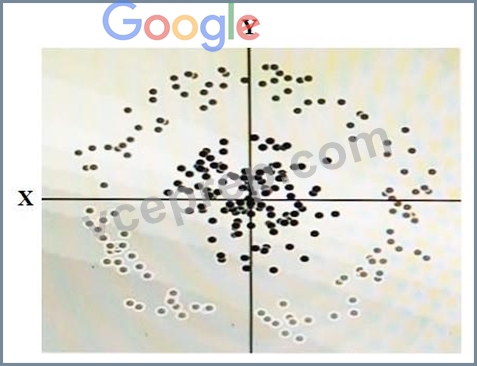
- A. Y^2
- B. cos(X)
- C. X^2+Y^2
- D. X^2
Answer: C
NEW QUESTION 54
You are working on a niche product in the image recognition domain. Your team has developed a model that is dominated by custom C++ TensorFlow ops your team has implemented. These ops are used inside your main training loop and are performing bulky matrix multiplications. It currently takes up to several days to train a model. You want to decrease this time significantly and keep the cost low by using an accelerator on Google Cloud. What should you do?
- A. Use Cloud GPUs after implementing GPU kernel support for your customs ops.
- B. Use Cloud TPUs without any additional adjustment to your code.
- C. Stay on CPUs, and increase the size of the cluster you're training your model on.
- D. Use Cloud TPUs after implementing GPU kernel support for your customs ops.
Answer: D
Explanation:
Cloud TPUs are not suited to the following workloads: [...] Neural network workloads that contain custom TensorFlow operations written in C++. Specifically, custom operations in the body of the main training loop are not suitable for TPUs.
NEW QUESTION 55
You launched a new gaming app almost three years ago. You have been uploading log files from the previous day to a separate Google BigQuery table with the table name format LOGS_yyyymmdd. You have been using table wildcard functions to generate daily and monthly reports for all time ranges. Recently, you discovered that some queries that cover long date ranges are exceeding the limit of 1,000 tables and failing. How can you resolve this issue?
- A. Create separate views to cover each month, and query from these views
- B. Enable query caching so you can cache data from previous months
- C. Convert the sharded tables into a single partitioned table
- D. Convert all daily log tables into date-partitioned tables
Answer: D
Explanation:
Explanation
NEW QUESTION 56
Your company receives both batch- and stream-based event data. You want to process the data using Google Cloud Dataflow over a predictable time period. However, you realize that in some instances data can arrive late or out of order. How should you design your Cloud Dataflow pipeline to handle data that is late or out of order?
- A. Use watermarks and timestamps to capture the lagged data.
- B. Ensure every datasource type (stream or batch) has a timestamp, and use the timestamps to define the logic for lagged data.
- C. Set a single global window to capture all the data.
- D. Set sliding windows to capture all the lagged data.
Answer: D
NEW QUESTION 57
You've migrated a Hadoop job from an on-prem cluster to dataproc and GCS. Your Spark job is a complicated analytical workload that consists of many shuffing operations and initial data are parquet files (on average
200-400 MB size each). You see some degradation in performance after the migration to Dataproc, so you'd like to optimize for it. You need to keep in mind that your organization is very cost-sensitive, so you'd like to continue using Dataproc on preemptibles (with 2 non-preemptible workers only) for this workload.
What should you do?
- A. Switch to TFRecords formats (appr. 200MB per file) instead of parquet files.
- B. Switch from HDDs to SSDs, override the preemptible VMs configuration to increase the boot disk size.
- C. Increase the size of your parquet files to ensure them to be 1 GB minimum.
- D. Switch from HDDs to SSDs, copy initial data from GCS to HDFS, run the Spark job and copy results back to GCS.
Answer: D
NEW QUESTION 58
......
The benefit of obtaining the Google Professional Data Engineer Exam Certification
A Professional Data Engineer enables data-driven decision making by collecting, transforming, and publishing data. A data engineer should be able to design, build, operationalize, secure, and monitor data processing systems with a particular emphasis on security and compliance; scalability and efficiency; reliability and fidelity; and flexibility and portability. A data engineer should also be able to leverage, deploy, and continuously train pre-existing machine learning models.
Get Professional-Data-Engineer Braindumps & Professional-Data-Engineer Real Exam Questions: https://www.vceprep.com/Professional-Data-Engineer-latest-vce-prep.html
Google Professional-Data-Engineer Actual Questions and Braindumps: https://drive.google.com/open?id=1SHkz9xqBWC4xT4BONbXlbQib8ysrU7oZ