


JN0-253 Exam Practice Questions prepared by Juniper Professionals
Use Valid New JN0-253 Questions - Top choice Help You Gain Success
Juniper JN0-253 Exam Syllabus Topics:
| Topic | Details |
|---|---|
| Topic 1 |
|
| Topic 2 |
|
| Topic 3 |
|
| Topic 4 |
|
NEW QUESTION # 47
According to Juniper Networks, what are two best practices for AP placement (excluding AP12) for optimal accuracy and stability of location-based services? (Choose two.)
- A. Enable a wireless mesh.
- B. Mount the AP above the ceiling, the LED orientation does not matter.
- C. Each AP should have an unobstructed fine of sight to at least two other APs.
- D. Mount the AP on the ceiling with the LED facing the floor.
Answer: C,D
Explanation:
Line of Sight: For optimal accuracy and stability of location-based services, each access point (AP) should have an unobstructed line of sight to at least two other APs. This ensures robust triangulation and accurate location tracking.
Ceiling Mounting: Mounting APs on the ceiling with the LED facing the floor is recommended.
This position provides the best coverage and performance for both Wi-Fi and BLE signals, essential for reliable location services.
NEW QUESTION # 48
Which Juniper Mist feature tracks the location of important devices and objects within a building?
- A. Wireless Assurance
- B. User Engagement
- C. IoT Assurance
- D. Asset Visibility
Answer: D
Explanation:
TheJuniper Mist Asset Visibilityservice provides real-time tracking and visibility for important devices and objects within indoor environments such as hospitals, offices, or warehouses. It usesBluetooth Low Energy (BLE)technology andMist vBLE-enabled access pointsto determine the precise location of tagged assets.
According to theJuniper Mist Location Services Guide, the feature is defined as:
"Asset Visibility leverages virtual Bluetooth LE technology and BLE tags to locate and track assets on floor plans in real time, providing actionable location-based intelligence." Key functionalities include:
* Tracking BLE-tagged assets such as medical equipment, IT devices, or inventory.
* Displaying live location information on floor maps.
* Integrating with external asset management or workflow systems.
WhileUser Engagementfocuses on customer-facing location experiences (e.g., navigation or proximity marketing),Asset Visibilityis designed specifically for internal asset monitoring and operational efficiency.
Therefore, the correct answer isC. Asset Visibility.
References:- Juniper Mist Location-Based Services and Asset Visibility Guide- Juniper Mist AI for Asset Tracking and BLE Technology Overview- Juniper Mist Cloud Location Services Documentation
NEW QUESTION # 49
Which location-based service does User Engagement provide?
- A. ultra wide band location
- B. Wi-Fi presence analytics
- C. asset tracking
- D. wayfinding
Answer: B
NEW QUESTION # 50
Which statement correctly describes the purpose of Juniper Mist "Site Groups"?
- A. Site Groups are used to apply configuration templates or policies consistently across multiple related sites.
- B. Site Groups can only contain a single site.
- C. Site Groups automatically delete inactive sites after 30 days.
- D. Site Groups are only used for licensing purposes.
Answer: A
Explanation:
Site Groups in Juniper Mist allow administrators to logically group multiple sites together so that configuration templates, policies, or settings can be applied consistently across all sites within the group, simplifying management for organizations with many similar locations.
NEW QUESTION # 51
Which two statements are true about switch configurations at the site level? (Choose two.)
- A. Switch configurations at the site level are an additional way to apply a switch template to a specific site.
- B. Switch configurations at the site level are required to manually configure individual switches.
- C. Organizational-level templates override site-level switch configurations.
- D. Site-level switch configurations override org-level templates.
Answer: A,D
Explanation:
In theJuniper Mist Cloud architecture, configuration hierarchy and inheritance are key design principles for managingEX SeriesandQFX Seriesswitches underWired Assurance. Configuration settings can be applied at both theorganization leveland thesite level, with clearly defined precedence rules.
According to theJuniper Mist Wired Assurance Configuration Guide, theorganization leveldefines global configuration templates that apply across multiple sites, while thesite levelprovides customization options specific to a particular location or environment.
The documentation states:
"Site-level configuration overrides any global or organizational template configurations for switches within that site." and further clarifies:
"Administrators can create or modify switch templates at the site level to apply custom settings to specific deployments without affecting other sites under the same organization." Thus:
* Statement Cis correct - site-level configurations are an additional method to apply templates for a specific site.
* Statement Dis correct - site-level configurationstake precedenceover org-level templates.
Statement Ais incorrect because org-level templates donotoverride site-level configurations; the reverse is true.
Statement Bis incorrect because site-level configuration isnot requiredfor manual switch setup-it is an optional, more efficient method of template application.
References:- Juniper Mist Wired Assurance Configuration and Template Management Guide- Juniper Mist Cloud Administration Guide- Juniper Mist Site and Organization Configuration Hierarchy Documentation
NEW QUESTION # 52
Which two components make up a self-driving AI network? (Choose two.)
- A. actions
- B. support tickets
- C. telemetry
- D. human interface
Answer: A,C
Explanation:
A self-driving AI network is comprised of two foundational components: actions and telemetry. According to Juniper's own communications, "Marvis AI analyzes telemetry across the wired, wireless, WAN and data center domains, and creates automated workflows to simplify operations and lower costs. Agentic AI:
Accelerating self-driving operations." Telemetry provides real-time continuous data and metrics from the network, including client, device, and application health, enabling the AI engine to build a current, actionable state model. Actions refer to proactive, automated tasks performed by the AI, such as remediating misconfigured ports, resolving anomalies, optimizing performance, and self-healing operations-"Expanded Self-Driving Actions... the Marvis Actions dashboard now supports the autonomous remediation of more network issues." Human interface and support tickets are beneficial for management and support, but the core capabilities of a self-driving AI network are telemetry (data/observability) and actions (automation
/remediation).
Reference:HPE Juniper Networking Self-Driving Network Overview
NEW QUESTION # 53
What are two guest portal authentication options in the UI? (Choose two.)
- A. Sponsored Guest
- B. MAC Authentication
- C. Authentication Code
- D. SAML
Answer: A,C
Explanation:
Sponsored Guest allows visitors to gain access through approval by an internal sponsor.
Authentication Code provides guests with a temporary code to authenticate through the portal.
NEW QUESTION # 54
Which three categories of alert types are available in Juniper Mist? (Choose three.)
- A. Infrastructure
- B. Site
- C. Users
- D. Security
- E. Marvis
Answer: A,D,E
Explanation:
Alerts represent network and device issues that are ongoing. Juniper Mist™ categorizes them as follows:
* Infrastructure Alerts-Repeated events involving servers and protocols that can potentially affect a large number of clients. For example, an event during which a Domain Name System (DNS), Dynamic Host Configuration Protocol (DHCP), or RADIUS server is unreachable can affect many clients.
Similarly, if a power supply on a switch is in alarm state, a large number of clients and a large amount of traffic could be affected.
* Marvis Alerts-Repeated events that Marvis tracks on the Marvis Actions dashboard. For example, if an access point (AP) regularly fails health checks, you'll see a Marvis alert for it.
* Security Alerts-Repeated events that could dramatically affect network security. For example, these alerts appear if a rogue AP is detected and clients start connecting to it.
* Certificate Alerts-Notification for expired, and soon-to-expire, user-added digital certificates. These include RadSec (configured at Organization > Settings > RadSec Certificates and AP RadSec certificate), SSO (configured at Organization > Settings > Single Sign-On), and PSK Portal IDP certificates (configured at Organization > Client Onboarding). Certificate alerts appear on the Alerts page and begin 30 days before the certificate's expiry date, then the notification repeats 15, 7, 3, and 1 day before expiration unless the certificate is renewed. .
https://www.juniper.net/documentation/us/en/software/mist/mist-aiops/topics/concept/alerts-overview.html
NEW QUESTION # 55
Which two statements are correct about Juniper Mist subscriptions? (Choose two.)
- A. If a device fails and is removed from the network, you must manually transfer the subscription to the new device before installing.
- B. Subscriptions are associated with a specific device serial number.
- C. Subscriptions are not associated with a specific device serial number.
- D. If a device fails and is removed from the network, the subscription will automatically apply to the new device when added.
Answer: B,D
Explanation:
Subscriptions automatically follow the device license model, so if a device is replaced under RMA, the subscription will apply to the new unit.
Subscriptions are tied to a specific device serial number, ensuring proper entitlement and tracking.
NEW QUESTION # 56
Which statement is correct about Service Level Expectations (SLEs) in Juniper Mist?
- A. SLEs measure and quantify the user experience across metrics such as Time to Connect, Throughput, and Coverage.
- B. SLEs are static thresholds manually configured by the administrator for every site.
- C. SLEs only apply to wired switching, not wireless.
- D. SLEs cannot be broken down into contributing classifiers.
Answer: A
Explanation:
Service Level Expectations (SLEs) in Juniper Mist are AI-driven metrics that quantify the end-user network experience across dimensions such as Time to Connect, Successful Connects, Throughput, Roaming, and Coverage. Each SLE can be broken down into classifiers and sub- classifiers to help pinpoint the root cause of any degradation.
NEW QUESTION # 57
Which two statements are true about packet captures on an AP? (Choose two.)
- A. The involved APs remain in service.
- B. The involved APs are taken out of service.
- C. Only wireless packets can be captured.
- D. Wireless and wired packets can be captured.
Answer: A,D
Explanation:
Mist APs have the capability to capture both wireless and wired packets. This feature allows for comprehensive network troubleshooting by providing visibility into both types of traffic. When performing packet captures on Mist APs, the APs remain in service. This means they continue to operate and serve clients while the capture is ongoing, ensuring minimal disruption to network operations.
This functionality is critical for maintaining network availability and performance while conducting detailed packet analysis.
NEW QUESTION # 58
Click the Exhibit button.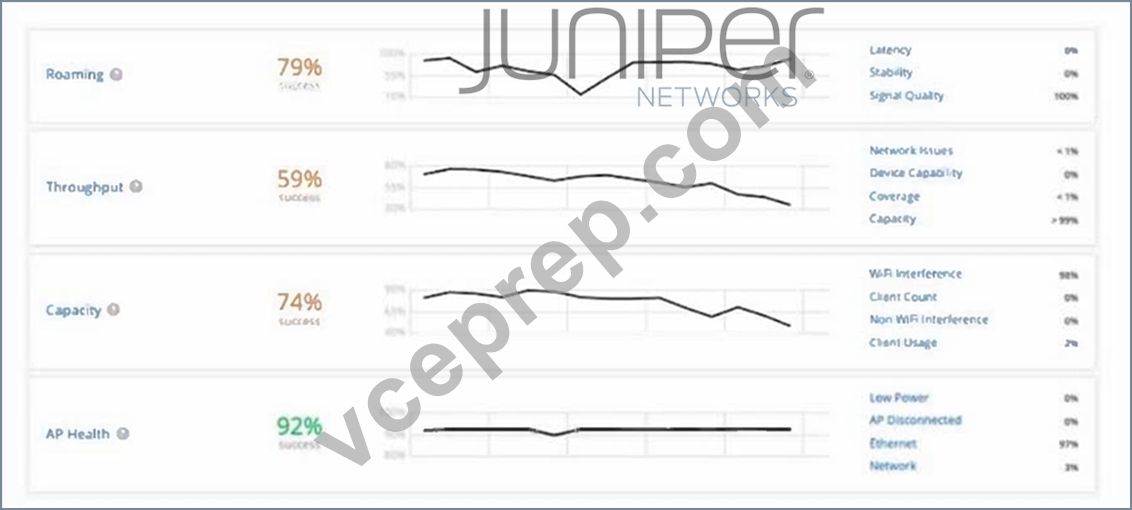
Referring to the exhibit, which Roaming Classifier is responsible for the sub-threshold SLEs?
- A. Ethernet
- B. Capacity
- C. WiFi interference
- D. Signal Quality
Answer: D
Explanation:
In the exhibit, the Roaming Success Level Experience (SLE) shows 79% success, with classifiers listed as Latency (0%), Stability (0%), and Signal Quality (100%). Since Signal Quality is the only classifier fully responsible for influencing the roaming SLE, it indicates that issues with signal quality are causing the sub-threshold performance.
NEW QUESTION # 59
Which two Wi-Fi related SLEs are visible in the Mist UI? (Choose two.)
- A. Switch Health
- B. Throughput
- C. Capacity
- D. Application Health
Answer: B,C
Explanation:
Wi-Fi Related SLEs in Mist UI:
SLEs (Service Level Expectations) help monitor and ensure Wi-Fi network performance.
Visible SLEs:
Capacity:
Capacity SLE monitors the network's ability to handle the number of connected clients and their bandwidth requirements.
Throughput:
Throughput SLE measures the data transfer rates, ensuring that the network meets the expected performance levels.
NEW QUESTION # 60
What are three methods for requesting authentication in the Juniper Mist API? (Choose three.)
- A. Enable MFA with Okta Verify.
- B. Use OAuth2 linked to an OAuth provider.
- C. Enable basic authentication with a token.
- D. Use RADIUS certificates.
- E. Use an HTTPS login with a user name and password.
Answer: B,C,E
Explanation:
OAuth2 linked to an OAuth provider for token-based access.
HTTPS login using a username and password.
Token-based authentication (basic authentication with an API token).
NEW QUESTION # 61
What is required for Marvis Minis to operate?
- A. WAN Assurance subscription
- B. Premium Analytics subscription
- C. minimum AP firmware
- D. WLAN template
Answer: C
Explanation:
Marvis Minis run directly on Mist access points, so the only requirement is that the APs have the minimum supported firmware version. No additional subscriptions or templates are needed for them to operate.
NEW QUESTION # 62
Marvis has notified you that you have a bad cable. What additional information does the Marvis Actions dashboard provide to help you solve the issue?
- A. The switch port to which the cable is connected.
- B. The category rating of the cable.
- C. Which of the eight Ethernet wires are broken.
- D. If the port or cable is at fault.
Answer: D
Explanation:
The Marvis Actions dashboard not only alerts you of a bad cable but also provides diagnostic insight to determine whether the issue lies with the cable itself or the switch port, helping to quickly isolate and resolve the problem.
NEW QUESTION # 63
Which two Mist location tracking components run in the cloud? (Choose two.)
- A. location sensor
- B. BLE tag
- C. location engine
- D. location system
Answer: C,D
Explanation:
Location Engine: The location engine runs in the cloud and processes data from BLE tags and sensors to determine the location of devices within a network. It performs the necessary computations to provide accurate location tracking and analytics.
Location System: The location system, also cloud-based, integrates with the location engine to provide a complete solution for tracking and managing location data within Mist's ecosystem. This system supports various applications such as asset tracking, wayfinding, and proximity-based services.
NEW QUESTION # 64
Which protocol does Mist cloud use to send and receive data to connected access points?
- A. SSH
- B. MQTT
- C. HTTPS
- D. PPTP
Answer: C
Explanation:
Mist Cloud Communication Protocol: The Mist cloud platform uses HTTPS (Hypertext Transfer Protocol Secure) to communicate with connected access points. This ensures that the data sent and received is encrypted and secure, adhering to modern security standards(Juniper Networks).
Security and Reliability: Using HTTPS provides a secure channel over which configuration changes, updates, and monitoring data can be safely transmitted between the Mist cloud and the access points. This protocol is widely accepted and trusted for secure communications over the internet.
NEW QUESTION # 65
What should be specified in the session policy settings?
- A. The types of special characters allowed in the password.
- B. The duration for session timeout and inactivity timeout.
- C. The implementation of two-factor authentication (2FA).
- D. The minimum number of characters required for the password.
Answer: B
Explanation:
Thesession policy settingsin theJuniper Mist Clouddefine how long a user session remains active and how the system manages session expirations due to inactivity. These configurations help ensure bothsecurityand efficient resource managementacross the Mist Cloud portal and API sessions.
According to theJuniper Mist Cloud Administration and Security Configuration Guide:
"Session policy defines session timeout and inactivity timeout parameters, controlling how long users can remain logged into the Mist Cloud portal or API before re-authentication is required."
* Session Timeout:Specifies the maximum duration a session can remain active, regardless of activity.
* Inactivity Timeout:Defines how long a session can remain idle before automatic logout.
These policies help maintain strong access security by reducing the risk of unauthorized access through stale sessions.
Other options such as password complexity (A, C) and two-factor authentication (D) are configured under authentication and access policies, not session policies.
Therefore, the correct answer isB. The duration for session timeout and inactivity timeout.
References:- Juniper Mist Cloud Administration and Security Configuration Guide- Juniper Mist Organization Access and Authentication Policy Documentation- Juniper Mist Cloud Operations and Management Overview
NEW QUESTION # 66
......
JN0-253 Exam Practice Materials Collection: https://www.vceprep.com/JN0-253-latest-vce-prep.html
Get Latest and 100% Accurate JN0-253 Exam Questions: https://drive.google.com/open?id=1xTEpjbKAkLU4b4jmISJyfpM6W5DACxXJ