


Pass Palo Alto Networks Cybersecurity-Practitioner Actual Free Exam Q&As Updated Dump May 01, 2026
Latest Cybersecurity-Practitioner Actual Free Exam Updated 227 Questions
Palo Alto Networks Cybersecurity-Practitioner Exam Syllabus Topics:
| Topic | Details |
|---|---|
| Topic 1 |
|
| Topic 2 |
|
| Topic 3 |
|
| Topic 4 |
|
NEW QUESTION # 37
Based on how much is managed by the vendor, where can CaaS be situated in the spread of cloud computing services?
- A. between IaaS and PaaS
- B. between FaaS and Serverless
- C. between On-Prem and IaaS
- D. between PaaS and FaaS
Answer: A
Explanation:
CaaS, or Containers-as-a-Service, is a cloud service that allows users to manage and deploy applications using containers and clusters. CaaS can be situated between IaaS and PaaS in the spread of cloud computing services, based on how much is managed by the vendor. IaaS, or Infrastructure-as-a-Service, provides the lowest level of abstraction, where users have to manage the servers, storage, network, and operating system. PaaS, or Platform-as-a-Service, provides a higher level of abstraction, where users only have to manage the application code and data. FaaS, or Function-as-a-Service, provides the highest level of abstraction, where users only have to manage the functions or logic of the application. CaaS falls in between IaaS and PaaS, as it provides users with more control over the container orchestration and configuration than PaaS, but also simplifies the infrastructure management and scaling than IaaS123. Reference:
What is CaaS? from Red Hat
Containers as a Service from Atlassian
Container as a Service (CaaS) from GeeksforGeeks
NEW QUESTION # 38
Which security tool provides policy enforcement for mobile users and remote networks?
- A. Prisma Access
- B. Service connection
- C. Digital experience management
- D. Prisma Cloud
Answer: A
Explanation:
Prisma Access is a cloud-delivered security platform that provides policy enforcement, secure access, and threat prevention for mobile users and remote networks, ensuring consistent security regardless of location.
NEW QUESTION # 39
What is used to orchestrate, coordinate, and control clusters of containers?
- A. Kubernetes
- B. CN-Series
- C. Prisma Saas
- D. Docker
Answer: A
Explanation:
As containers grew in popularity and used diversified orchestrators such as Kubernetes (and its derivatives, such as OpenShift), Mesos, and Docker Swarm, it became increasingly important to deploy and operate containers at scale.
https://www.dynatrace.com/news/blog/kubernetes-vs-docker/
NEW QUESTION # 40
What is a key benefit of Cortex XDR?
- A. It secures internal network traffic against unknown threats.
- B. It manages applications accessible on endpoints.
- C. It acts as a safety net during an attack while patches are developed.
- D. It reduces the need for network security.
Answer: C
Explanation:
Cortex XDR is a detection and response platform that natively integrates network, endpoint, and cloud data to stop sophisticated attacks. A key benefit of Cortex XDR is that it acts as a safety net during an attack while patches are developed. Cortex XDR uses machine learning and behavioral analytics to detect and validate threats, and automatically reveals the root cause of alerts to speed up investigations. Cortex XDR also enables flexible and rapid response actions to contain and remediate threats across the environment. Reference: Cortex XDR- Extended Detection and Response - Palo Alto Networks, What is Cortex XDR | Palo Alto Networks, Cortex XDR Datasheet - Palo Alto Networks
NEW QUESTION # 41
Match the IoT connectivity description with the technology.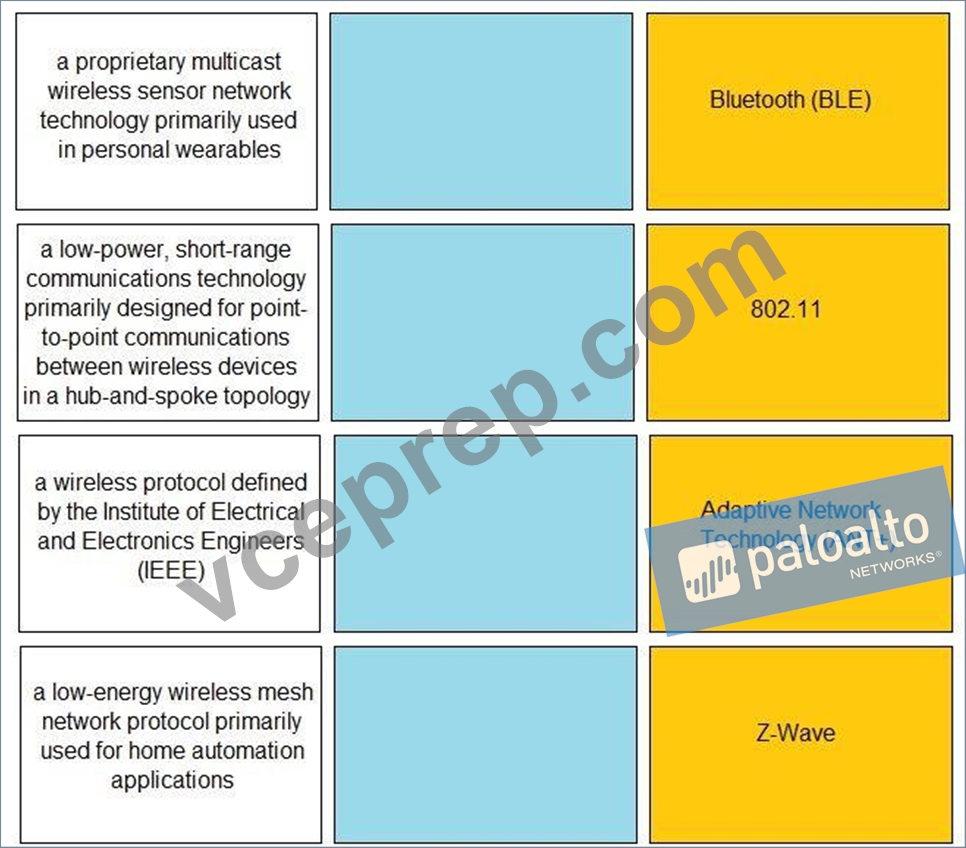
Answer:
Explanation: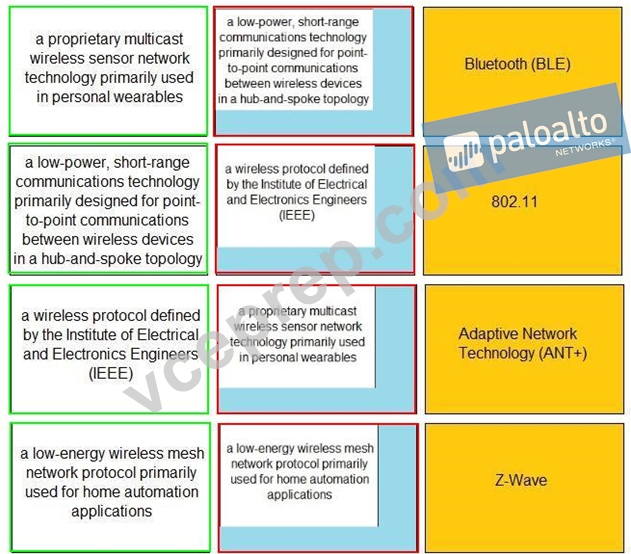
NEW QUESTION # 42
Which of the following is a service that allows you to control permissions assigned to users in order for them to access and utilize cloud resources?
- A. User-ID
- B. Lightweight Directory Access Protocol (LDAP)
- C. Identity and Access Management (IAM)
- D. User and Entity Behavior Analytics (UEBA)
Answer: C
Explanation:
Identity and access management (IAM) is a software service or framework that allows organizations to define user or group identities within software environments, then associate permissions with them. The identities and permissions are usually spelled out in a text file, which is referred to as an IAM policy.
NEW QUESTION # 43
Web 2.0 applications provide which type of service?
- A. PaaS
- B. SaaS
- C. FWaaS
- D. IaaS
Answer: B
Explanation:
Web 2.0 applications provide the type of service known as Software as a Service (SaaS). SaaS is a cloud computing model that allows users to access and use web-based applications over the internet, without having to install or maintain any software on their own devices. SaaS applications are hosted and managed by a third-party provider, who is responsible for the security, performance, availability, and updates of the software. SaaS applications are typically accessed through a web browser or a mobile app, and offer features such as user-generated content, social networking, collaboration, and interoperability. Examples of Web 2.0 SaaS applications include Facebook, X, Wikipedia, Gmail, and Salesforce. Reference:
What Is Web 2.0? Definition, Impact, and Examples - Investopedia
Web 2.0 - Wikipedia
[What is SaaS? Software as a service (SaaS) definition - Salesforce.com]
NEW QUESTION # 44
In addition to integrating the network and endpoint components, what other component does Cortex integrate to speed up IoC investigations?
- A. Computer
- B. Infrastructure
- C. Switch
- D. Cloud
Answer: D
Explanation:
Cortex XDR breaks the silos of traditional detection and response by natively integrating network, endpoint, and cloud data to stop sophisticated attacks
NEW QUESTION # 45
Which technology helps Security Operations Center (SOC) teams identify heap spray attacks on company-owned laptops?
- A. ASM
- B. CSPM
- C. CVVP
- D. EDR
Answer: D
Explanation:
Heap spray attacks exploit memory management vulnerabilities by injecting malicious code into a program's heap to manipulate execution flow. Endpoint Detection and Response (EDR) platforms monitor memory and process behavior on endpoints, enabling the detection of such memory-based exploits through anomaly and behavior analysis. Palo Alto Networks' Cortex XDR equips SOC teams with the tools to detect, analyze, and respond to heap spray and other in-memory attacks on company laptops in real time. EDR's endpoint-centric visibility is crucial since heap spray attacks operate below network layers and often bypass traditional perimeter defenses.
NEW QUESTION # 46
In which step of the cyber-attack lifecycle do hackers embed intruder code within seemingly innocuous files?
- A. reconnaissance
- B. delivery
- C. weaponization
- D. exploitation
Answer: C
Explanation:
"Weaponization: Next, attackers determine which methods to use to compromise a target endpoint. They may choose to embed intruder code within seemingly innocuous files such as a PDF or Microsoft Word document or email message."
NEW QUESTION # 47
Which statement describes DevOps?
- A. DevOps is a combination of the Development and Operations teams
- B. DevOps is its own separate team
- C. DevOps is a set of tools that assists the Development and Operations teams throughout the softwaredelivery process
- D. DevOps is a culture that unites the Development and Operations teams throughout the software delivery process
Answer: D
Explanation:
DevOps is not:
* A combination of the Dev and Ops teams: There still are two teams; they just operate in a communicative, collaborative way.
* Its own separate team: There is no such thing as a "DevOps engineer." Although some companies may appoint a "DevOps team" as a pilot when trying to transition to a DevOps culture, DevOps refers to a culture where developers, testers, and operations personnel cooperate throughout the entire software delivery lifecycle.
* A tool or set of tools: Although there are tools that work well with a DevOps model or help promote DevOps culture, DevOps ultimately is a strategy, not a tool.
* Automation: Although automation is very important for a DevOps culture, it alone does not define DevOps.
NEW QUESTION # 48
In the network diagram below, which device is the router?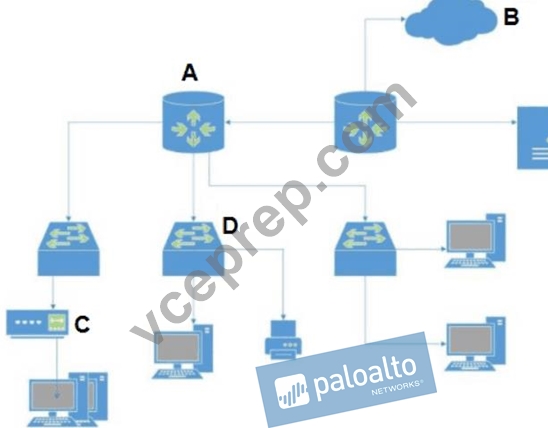
- A. B
- B. A
- C. C
- D. D
Answer: A
Explanation:
In the given network diagram, device D is depicted as a cloud symbol, which is commonly used to represent the internet in network diagrams. The router is typically connected to the internet and acts as a gateway for internal network devices to access external networks. Therefore, device D is the router in this context. Reference: Virtual Router Overview - Palo Alto Networks | TechDocs, Networking (UDRs) in Azure: Inserting the VM-Series into an Azure ..., Setting Up the PA-200 for Home and Small Office - Palo Alto Networks ...
NEW QUESTION # 49
Which two workflows are improved by integrating SIEMs with other security solutions? (Choose two.)
- A. Incident response
- B. Log normalization
- C. Initial security team training
- D. Hardware procurement
Answer: A,B
Explanation:
Log normalization - SIEMs standardize log formats from various sources, making it easier to analyze and correlate security events.
Incident response - Integration enables faster detection, investigation, and automated or guided response to security incidents by using correlated data from multiple tools.
Hardware procurement and security team training are not directly influenced by SIEM integration.
NEW QUESTION # 50
The customer is responsible only for which type of security when using a SaaS application?
- A. data
- B. infrastructure
- C. platform
- D. physical
Answer: A
Explanation:
Data security is the only type of security that the customer is fully responsible for when using a SaaS application. Data security refers to the protection of data from unauthorized access, use, modification, deletion, or disclosure. Data security includes aspects such as encryption, backup, recovery, access control, and compliance12. The customer is responsible for ensuring that their data is secure in transit and at rest, and that they comply with any applicable regulations or policies regarding their data.
The other types of security - physical, platform, and infrastructure - are the responsibility of the SaaS provider. Physical security refers to the protection of the hardware and facilities that host the SaaS application. Platform security refers to the protection of the software and services that run the SaaS application. Infrastructure security refers to the protection of the network and systems that support the SaaS application. The SaaS provider is responsible for ensuring that these layers of security are maintained and updated, and that they meet the required standards and certifications34. Reference:
SaaS and the Shared Security Model
A Guide to SaaS Shared Responsibility Model
The Shared Responsibility Model for Security in The Cloud (IaaS, PaaS & SaaS) Shared responsibility in the cloud
NEW QUESTION # 51
Which internet of things (loT) connectivity technology operates on the 2.4GHz and 5GHz bands, as well as all bands between 1 and 6GHz when they become available for 802.11 use. at ranges up to 11 Gbit/s?
- A. C-band
- B. 802.11ax
- C. Z-wave
- D. 3G
Answer: B
Explanation:
802.11ax, also known as Wi-Fi 6, is an internet of things (IoT) connectivity technology that operates on the 2.4GHz and 5GHz bands, as well as all bands between 1 and 6GHz when they become available for 802.11 use, at ranges up to 11 Gbit/s. 802.11ax is designed to improve the performance, efficiency, and capacity of wireless networks, especially in high-density environments such as smart homes, smart cities, and industrial IoT. 802.11ax uses various techniques such as orthogonal frequency division multiple access (OFDMA), multi-user multiple input multiple output (MU-MIMO), target wake time (TWT), and 1024 quadrature amplitude modulation (QAM) to achieve higher data rates, lower latency, longer battery life, and reduced interference for IoT devices. Reference:
* Wi-Fi 6 (802.11ax) - Palo Alto Networks
* What is Wi-Fi 6? | Wi-Fi 6 Features and Benefits | Cisco
* What is Wi-Fi 6 (802.11ax)? - Definition from WhatIs.com
NEW QUESTION # 52
What is a characteristic of the National Institute Standards and Technology (NIST) defined cloud computing model?
- A. requires the use of two or more cloud service providers
- B. defines any network service
- C. requires the use of only one cloud service provider
- D. enables on-demand network services
Answer: D
Explanation:
According to the NIST definition, cloud computing is a model for enabling ubiquitous, convenient, on-demand network access to a shared pool of configurable computing resources (e.g., networks, servers, storage, applications, and services) that can be rapidly provisioned and released with minimal management effort or service provider interaction1. One of the essential characteristics of cloud computing is on-demand self-service, which means that users can request and obtain computing resources as needed, without requiring human intervention from the service provider2. On-demand network services are an example of this characteristic, as they allow users to access network resources such as bandwidth, routing, firewall, or load balancing, on demand and in a scalable manner3. Reference:
The NIST definition of cloud computing
SP 800-145, The NIST Definition of Cloud Computing | CSRC
On-Demand Network Services - Palo Alto Networks
NEW QUESTION # 53
Which product functions as part of a SASE solution?
- A. Prisma SD-WAN
- B. Cortex
- C. Prisma Cloud
- D. Kubernetes
Answer: A
Explanation:
Prisma SD-WAN is a key component of a SASE (Secure Access Service Edge) solution. It provides intelligent routing, traffic optimization, and secure connectivity between users and applications, supporting the networking part of SASE alongside security services like those in Prisma Access.
NEW QUESTION # 54
You received an email, allegedly from a bank, that asks you to click a malicious link to take action on your account.
Which type of attack is this?
- A. Whaling
- B. Spear phishing
- C. Phishing
- D. Spamming
Answer: C
Explanation:
Phishing is a type of email attack where the attacker sends a lot of malicious emails in an untargeted way, pretending to be a trusted source, such as a bank or an online retailer, to trick users into revealing sensitive information, such as passwords or credit card numbers. Attackers use the information to steal money or to launch other attacks. A fake email from a bank asking you to click a link and verify your account details is an example of phishing1 Reference:
1: Palo Alto Networks Certified Cybersecurity Entry-level Technician - Palo Alto Networks
2: 10 Palo Alto Networks PCCET Exam Practice Questions - CBT Nuggets
3: Types of Email Attacks - Examples and Consequences - Tessian
4: What Is a Phishing Attack? Definition and Types - Cisco
NEW QUESTION # 55
At which layer of the OSI model are routing protocols defined?
- A. Physical
- B. Data Link
- C. Network
- D. Transport
Answer: C
Explanation:
Routing protocols are defined at the network layer (Layer 3) of the OSI model. The network layer is responsible for routing packets across different networks using logical addresses (IP addresses). Routing protocols are used to exchange routing information between routers and to determine the best path for data delivery. Some examples of routing protocols are BGP, OSPF, RIP, and EIGRP. Palo Alto Networks devices support advanced routing features using the Advanced Routing Engine1. Reference: Advanced Routing - Palo Alto Networks | TechDocs, What Is Layer 7? - Palo Alto Networks, How to Configure Routing Information Protocol (RIP)
NEW QUESTION # 56
......
Online Questions - Valid Practice Cybersecurity-Practitioner Exam Dumps Test Questions: https://www.vceprep.com/Cybersecurity-Practitioner-latest-vce-prep.html
100% Real Cybersecurity-Practitioner dumps - Brilliant Cybersecurity-Practitioner Exam Questions PDF: https://drive.google.com/open?id=1yISsnq3KNioilR1wVyEYIDP89Vkw8OMp